Time present and time past
Are both perhaps present in time future,
And time future contained in time past.
If all time is eternally present
All time is unredeemable.
What might have been is an abstraction
Remaining a perpetual possibility
Only in a world of speculation.
What might have been and what has been
Point to one end, which is always present.
Footfalls echo in the memory
Down the passage which we did not take
Towards the door we never opened
Into the rose-garden. My words echo
Thus in your mind.
But to what purpose
Disturbing the dust on a bowl of rose-leaves
I do not know.
Fond as I am of the word 'perhaps', I do wonder why Eliot had to include it here. Where was il miglior fabro? (I also wonder what Eliot, the jewel thief as Pound called him, actually knew about mud and axle trees, or even garlic and sapphires, come to that.)
But enough of that. What I wanted to remark was that we are living, now, in a historic moment. An historic moment? A truly historic moment? Perhaps even, for some, the last truly historic moment.
For we have arrived at the point perhaps where we began, where is is now formally recognised by the discerning that the word 'historic' can apply to anything in the past that we can only investigate, report and ponder upon. All time is unredeemable. Tous les matins du monde sont sans retour. To what purpose?
And so, at last, everything in the past qualifies for history, subject only to the interest of the news media, permission to disturb the dust on the bowl of rose-leaves. Mainly it involves police reports of socially egregious and criminal behaviour that formerly was tolerated.
It leaves us only to reflect whether the gratingly new usage is actually not less contentious than the old, although less useful - what is wrong with 'past'?


Showing posts with label T S Eliot. Show all posts
Showing posts with label T S Eliot. Show all posts
Monday, 26 August 2013
Sunday, 13 January 2013
Sweet Thames, run softly, till I end my song
 |
| New |
Owen Hatherley
 |
| Old |
Sweet Thames, run softly, for I speak not loud or long.
What became clear to the London Assembly’s Planning and Spatial Development Committee is that the Thames' understandable attraction as a location for exclusive residential development not only compromises the adequate provision of a riverside path but also results in the Thames being barricaded from its immediate hinterland and the rest of London.

Sunday, 28 August 2011
I had not thought death had undone so many

In an irony T S Eliot might himself have appreciated, and perhaps incorporated into one of his earlier poems, it is proposed to build 3700 houses in the fields next to East Coker, home of Eliot's ancestors, resting place of his own mortal remains and inspiration for the second of his Four Quartets - and, to its enduring misfortune, near neighbour of Yeovil.
A council spokesman said: "We absolutely acknowledge their concerns and we will look at each and every one of the comments that we have received."
In my beginning is my end. In succession
Houses rise and fall, crumble, are extended,
Are removed, destroyed, restored, or in their place
Is an open field, or a factory, or a by-pass.
Old stone to new building, old timber to new fires,
Old fires to ashes, and ashes to the earth
Which is already flesh, fur and faeces,
Bone of man and beast, cornstalk and leaf.
Houses live and die: there is a time for building
And a time for living and for generation
And a time for the wind to break the loosened pane
And to shake the wainscot where the field-mouse trots
And to shake the tattered arras woven with a silent motto.

It is difficult to judge what the later Eliot would really have thought of it. There would be no doubt with John Betjeman, but perhaps that means he was the surer, but less weighty poet. Eliot's poetry is still, in some sense, the touchstone of the 'modern', although it almost suggests, at times, a place in Private Eye, and the occasion of his writing is nearly a century in the past.

I said to my soul, be still, and wait without hope
For hope would be hope for the wrong thing; wait without love,
For love would be love of the wrong thing; there is yet faith
But the faith and the love and the hope are all in the waiting.

In a statement, Ric Pallister (perhaps he could drop the 't' by deed poll), leader of the Liberal Democrat-run South Somerset District Council, said it was "very definitely not in our interests to destroy East Coker or its setting".
He added, as he measured out his life in planning policies, a fate from which Eric Pickles, as immortalised in his new vision of England known as The Waste Land, is shortly to release him: "The proposals, which are still a work in progress in themselves, so far suggest that the general area to the south of Yeovil could be the best direction for growth, but there are no proposals to develop East Coker village."
Perhaps he should seek the advice of Ezra Pound, Il miglior fabbro. He'd cut out a thing or two. Come to think of it, what would Pound have done with the Four Quartets?
 |
| The young Pound |
The wounded surgeon plies the steel
That questions the distempered part
 |
| The older Pound, by Gaudier Brzeska |
 |
| Gaudier Brzeska: not to be confused with the above |
Sophie Gaudier-Brzeska died intestate in the Gloucestershire Mental hospital at Barnwood in March 1925. H.S.Ede acquired her estate in 1927 from the Treasury Solicitor, it included not only her writings, but also the estate of Henri Gaudier, with many of his works and papers. Ede drew extensively on the letters written by Gaudier to Sophie and her writings and other material when he published ‘A Life of Gaudier-Brzeska’ in 1930.
 |
| Sophie Brzeska |
 |
| Jim Ede |
Tuesday, 21 June 2011
Back to furniture
“To Generalize is to be an Idiot. To Particularize is the Alone Distinction of Merit.”
Blake was protesting against the culture of the eighteenth century in which all particularities were referenced to and judged against general standards of good taste, correctness and politeness (a quality then seen as much an essential component of art as of social behaviour).
Originality was thought as likely to be absurd as enlightening, and so slightly valued that Joshua Reynolds, whose Discourses Blake was annotating, could observe, "invention, strictly speaking, is little more than a new combination of those images which have been previously gathered and deposited in the memory."
T S Eliot remarked that so positive was the culture of that age that it crushed a number of smaller men who thought differently but could not bear to face the fact.
With Blake it was his own perception and vision that was positive and not to be crushed and his apprehension of the particular was not to be referenced to the general.
In our own times, we seem not to know whether we wish to particularise or generalise, and to have lost our confidence in both. We cherish the particular but have lost the sense of accumulated experience into which it might be placed. We are surrounded by a plethora of cultural signs so clamorous that they have driven out meaning. The world and its history has become a cultural and natural supermarket which we loot for our individual satisfaction.
So furniture designer-makers have recently been berating themselves for how infrequently they indulge in any critical commentary on furniture, but the response is thin, and focussed on assessment of this or that designer’s whole body of work rather than on the examination of individual pieces of furniture. Such comment puts us in the realm of claim and counter claim, some doubtless more intelligent or discriminating than others but none able to validate itself, as individual criticism could do.
The debate is more political (in a cultural sense) than critical. We have an unsatisfied need to give shape to our inchoate culture by ranking and sanctioning practitioners rather than artefacts, although usually it is done politely, by quiet selection or exclusion rather than by manifesto or denunciation. Yet, however it is done, the process of creation, whereby individual perception is transmuted into something less limitingly personal is devalued, vulgarised or commercialised.
We have lost confidence in meaning or significance: objects are classed as ‘iconic’, without any sense of what they signify, simply because they are striking and frequently referenced. Furniture is ‘expressive’ without our having any sense of what it expresses. Little did Le Corbusier know what he was about to visit on the poor humble chair when he declared it to be ‘art’. Modern designer-maker furniture sometimes seems more ‘gestural’ than ‘expressive’, typified by the extravagant curve or the enveloping surface texture, offering a route to distinctiveness, sophistication or soul, bypassing the kind of design or cultural awareness necessary to achieve that sense of newness and rightness that dawns quietly on the observer rather than loudly assaulting him.
Blake was protesting against the culture of the eighteenth century in which all particularities were referenced to and judged against general standards of good taste, correctness and politeness (a quality then seen as much an essential component of art as of social behaviour).
Originality was thought as likely to be absurd as enlightening, and so slightly valued that Joshua Reynolds, whose Discourses Blake was annotating, could observe, "invention, strictly speaking, is little more than a new combination of those images which have been previously gathered and deposited in the memory."
T S Eliot remarked that so positive was the culture of that age that it crushed a number of smaller men who thought differently but could not bear to face the fact.
With Blake it was his own perception and vision that was positive and not to be crushed and his apprehension of the particular was not to be referenced to the general.
In our own times, we seem not to know whether we wish to particularise or generalise, and to have lost our confidence in both. We cherish the particular but have lost the sense of accumulated experience into which it might be placed. We are surrounded by a plethora of cultural signs so clamorous that they have driven out meaning. The world and its history has become a cultural and natural supermarket which we loot for our individual satisfaction.
So furniture designer-makers have recently been berating themselves for how infrequently they indulge in any critical commentary on furniture, but the response is thin, and focussed on assessment of this or that designer’s whole body of work rather than on the examination of individual pieces of furniture. Such comment puts us in the realm of claim and counter claim, some doubtless more intelligent or discriminating than others but none able to validate itself, as individual criticism could do.
The debate is more political (in a cultural sense) than critical. We have an unsatisfied need to give shape to our inchoate culture by ranking and sanctioning practitioners rather than artefacts, although usually it is done politely, by quiet selection or exclusion rather than by manifesto or denunciation. Yet, however it is done, the process of creation, whereby individual perception is transmuted into something less limitingly personal is devalued, vulgarised or commercialised.
We have lost confidence in meaning or significance: objects are classed as ‘iconic’, without any sense of what they signify, simply because they are striking and frequently referenced. Furniture is ‘expressive’ without our having any sense of what it expresses. Little did Le Corbusier know what he was about to visit on the poor humble chair when he declared it to be ‘art’. Modern designer-maker furniture sometimes seems more ‘gestural’ than ‘expressive’, typified by the extravagant curve or the enveloping surface texture, offering a route to distinctiveness, sophistication or soul, bypassing the kind of design or cultural awareness necessary to achieve that sense of newness and rightness that dawns quietly on the observer rather than loudly assaulting him.
Wednesday, 6 April 2011
Pivot point
Garlic and sapphires in the mud
Clot the bedded axel-tree.
Recently a fellow furniture designer-maker commended another’s account of the development of our work for knowing ‘which pieces were pivotal’. Whilst I don’t want to dispute the ability of either of them to know what work is genuinely remarkable, I do query whether there is anything so specific, in the collective body of the current work of small furniture designer-makers, as a pivot, or whether we are actually aware of our work turning on (or ignoring) any key development.
We are in fact remarkably ill informed of what the rest of us are currently up to. Our work lacks a mode of publication and a nexus of sociability. We have the misfortune that our product is of sufficient substance to make it difficult for us to move around (we are unlikely to up sticks on a whim and go off to make furniture with our fellows in the south of France), but not of enough substance to make it impossible to ignore as hundreds troop by it on their way to work. It is insufficiently artistic, insufficiently valuable, insufficiently new to be much remarked by critics and commentators. It is too expensive to matter much to the masses. The old network of patronage that used to advance fashions in interior taste has passed away, and those who come closest nowadays to setting public taste or fashion often do so without much commissioning or patronising the work themselves.
So how is new work communicated, even amongst ourselves? We might expect to see our fellows’ work at exhibitions, but furniture exhibitions are in notoriously short supply, unprofitable for their organisers and not always well supported by exhibitors with their best and newest work. Nearly all of us have websites, but few are good at updating them with their latest work. We could in fact quite easily do more than we do to communicate our newest ideas and designs: our association could easily – but does not – have a place in the members’ section of its website specifically for such communication.
I believe we don’t do more to communicate our latest work because we do not want to. We do not want to partly for our own reasons of ‘commercial confidentiality’ (I have more often seen members fret about plagiarism than enthuse that others are developing similar ideas to their own), and partly because we simply do not have much in the way of ideas to communicate.
Having claimed that our work collectively lacks particular direction or sense of purpose, I will now contradict myself (up to a point) by trying to identify some common elements in the most noticed furniture.
One recently discernible is the creation, almost the imposition of textured effects on timber surfaces. Pieces of furniture with this characteristic have been the leading items in several recent group exhibitions in London associated with DMOU. Sometimes, not always, rather than exploiting texture inherent in the material, the surface effects are created with techniques similar to those needed to produce the dead-smooth, high-finish surfaces of the ‘I can’t believe it’s not plastic’ type that many have come inescapably to associate with expensive ‘bespoke’ furniture. Sometimes in these pieces, also, the surface texture is the focus to the noticeable neglect of interest in underlying form.
In that respect it may possibly be a parallel to Martin Grierson’s belief that ‘the success and beauty of a design lie as much in the quality of detail and choice of materials as in the overall concept’. I don’t entirely disagree with that, but I do think it may beg the question whether there is a stable and mature vocabulary of form on which the designer-maker draws. Yet perhaps that is what Martin encompasses in his reference to ‘proper pieces of furniture that exploit traditional forms’.
So, if that is the garlic, where are the sapphires? Elsewhere in these London exhibitions an interest in differentiation by conspicuous form still thrives, with, sometimes, a virtuoso predilection for forms that dramatically challenge methods of timber construction and making ability. A delight in pushing things to extremes – in construction, detailing, refinement, and, in consequence, probably cost – has something to be said for it, and something against. It could be seen as part of the overloading of our culture with a multitude of signs. It can hardly form the basis for a movement – flux perhaps but not a movement in any direction. It cannot be that ‘pivot point’ we seek.
It is, however, what frequently receives the prizes and guildmarks for ‘bespoke’ furniture, although, ironically, the particular pieces that receive these accolades are sometimes not bespoken at all but are instead deliberate speculative punts at awards by designer-makers, and, even so decorated, they may struggle to find purchasers thereafter.
Whether any of this can amount to a continuation of the Arts and Crafts ‘legacy’ (the theme of these exhibitions), beyond a degree of self-regard in our work as furniture designer-makers, I personally doubt. It certainly does not constitute ‘wonderful furniture of a commonplace kind’, to use Ernest Gimson’s description of WR Lethaby’s furniture in the 1890 Arts and Crafts exhibition.
What exactly is meant by that phrase is a little problematic. It perhaps applies more to Gimson’s work than Lethaby’s. Lethaby did not actually design much furniture (or architecture come to that) and some of it might not universally be regarded as commonplace. Nor is it without decoration. But perhaps this is a subject to which I might return.
Clot the bedded axel-tree.
Recently a fellow furniture designer-maker commended another’s account of the development of our work for knowing ‘which pieces were pivotal’. Whilst I don’t want to dispute the ability of either of them to know what work is genuinely remarkable, I do query whether there is anything so specific, in the collective body of the current work of small furniture designer-makers, as a pivot, or whether we are actually aware of our work turning on (or ignoring) any key development.
We are in fact remarkably ill informed of what the rest of us are currently up to. Our work lacks a mode of publication and a nexus of sociability. We have the misfortune that our product is of sufficient substance to make it difficult for us to move around (we are unlikely to up sticks on a whim and go off to make furniture with our fellows in the south of France), but not of enough substance to make it impossible to ignore as hundreds troop by it on their way to work. It is insufficiently artistic, insufficiently valuable, insufficiently new to be much remarked by critics and commentators. It is too expensive to matter much to the masses. The old network of patronage that used to advance fashions in interior taste has passed away, and those who come closest nowadays to setting public taste or fashion often do so without much commissioning or patronising the work themselves.
So how is new work communicated, even amongst ourselves? We might expect to see our fellows’ work at exhibitions, but furniture exhibitions are in notoriously short supply, unprofitable for their organisers and not always well supported by exhibitors with their best and newest work. Nearly all of us have websites, but few are good at updating them with their latest work. We could in fact quite easily do more than we do to communicate our newest ideas and designs: our association could easily – but does not – have a place in the members’ section of its website specifically for such communication.
I believe we don’t do more to communicate our latest work because we do not want to. We do not want to partly for our own reasons of ‘commercial confidentiality’ (I have more often seen members fret about plagiarism than enthuse that others are developing similar ideas to their own), and partly because we simply do not have much in the way of ideas to communicate.
Having claimed that our work collectively lacks particular direction or sense of purpose, I will now contradict myself (up to a point) by trying to identify some common elements in the most noticed furniture.
One recently discernible is the creation, almost the imposition of textured effects on timber surfaces. Pieces of furniture with this characteristic have been the leading items in several recent group exhibitions in London associated with DMOU. Sometimes, not always, rather than exploiting texture inherent in the material, the surface effects are created with techniques similar to those needed to produce the dead-smooth, high-finish surfaces of the ‘I can’t believe it’s not plastic’ type that many have come inescapably to associate with expensive ‘bespoke’ furniture. Sometimes in these pieces, also, the surface texture is the focus to the noticeable neglect of interest in underlying form.
In that respect it may possibly be a parallel to Martin Grierson’s belief that ‘the success and beauty of a design lie as much in the quality of detail and choice of materials as in the overall concept’. I don’t entirely disagree with that, but I do think it may beg the question whether there is a stable and mature vocabulary of form on which the designer-maker draws. Yet perhaps that is what Martin encompasses in his reference to ‘proper pieces of furniture that exploit traditional forms’.
So, if that is the garlic, where are the sapphires? Elsewhere in these London exhibitions an interest in differentiation by conspicuous form still thrives, with, sometimes, a virtuoso predilection for forms that dramatically challenge methods of timber construction and making ability. A delight in pushing things to extremes – in construction, detailing, refinement, and, in consequence, probably cost – has something to be said for it, and something against. It could be seen as part of the overloading of our culture with a multitude of signs. It can hardly form the basis for a movement – flux perhaps but not a movement in any direction. It cannot be that ‘pivot point’ we seek.
It is, however, what frequently receives the prizes and guildmarks for ‘bespoke’ furniture, although, ironically, the particular pieces that receive these accolades are sometimes not bespoken at all but are instead deliberate speculative punts at awards by designer-makers, and, even so decorated, they may struggle to find purchasers thereafter.
Whether any of this can amount to a continuation of the Arts and Crafts ‘legacy’ (the theme of these exhibitions), beyond a degree of self-regard in our work as furniture designer-makers, I personally doubt. It certainly does not constitute ‘wonderful furniture of a commonplace kind’, to use Ernest Gimson’s description of WR Lethaby’s furniture in the 1890 Arts and Crafts exhibition.
What exactly is meant by that phrase is a little problematic. It perhaps applies more to Gimson’s work than Lethaby’s. Lethaby did not actually design much furniture (or architecture come to that) and some of it might not universally be regarded as commonplace. Nor is it without decoration. But perhaps this is a subject to which I might return.
Tuesday, 22 March 2011
Is it Art?
A furniture maker's lament
We furniture designer-makers are much exercised by contemplation of the nature of what we do (as this blog may demonstrate). We start from the recognition, often very reluctant, that it is certainly ‘craft’. We quickly add that it is also ‘design’. Since the 1960s ‘design’ has had almost totally positive connotations. (In 1960 the Arts and Crafts Exhibition Society, founded in the 1880s by Walter Crane, William Morris and others, thought it wise to change its name to the Society of Designer Craftsmen – gender politics seemed of less concern.) So we are ‘designer-makers’, thus distinguishing ourselves from those craftspeople who ‘think’ only to the extent of considering the precision of their joints, who read popular amateur craft magazines, and who have a distressing tendency to sell their work in village halls. Yes, we are certainly designers.
Yet, half a century on, the attractions of being a designer have worn rather thin. Those Bauhausian certainties may still work if you are producing a revolutionary new hand drier, but if it’s another expensive table they don’t seem to achieve the high prices and glittering press to which we aspire. What we would really like to be is artists, working in studios, showing in proper galleries; not the Crafts Council (ironically universally despised for jilting craft for art) but the Arts Council.
Or rather, we would like to create ‘art’ (taking our cue from T.S. Eliot’s sniffy response to the young man seeking his advice on how to become a poet, that he could not understand anyone wanting to be a poet, although he could understand someone wanting to write poems).
Is what we do ‘art’? That is not an easy question to answer unless we can say what art is, and people seldom venture a definition of art except as a stepping stone en route to arguing a further point. But such light footwork leaves the foundation of any claim shaky and we would be best to think a little about the nature of art outside our own activities before laying any claim.
What is it then that I do when I hang a painting of, say, a seascape on my wall? (A bizarre and useless thing to do.) What is the intention of art?
At the most workaday level one might say that the painting extends the viewer’s experience: shows them something they haven’t seen before. That seems a little inadequate, at least in the visual arts, which must be one of our closest desired fine arts bedfellows, although in narrative literature there is much, past and present, that feels no need to stake a higher claim to justify itself as art. But let us look beyond.
My seascape, Dutch master or Turner, may change the way in which I perceive the sea, not just the sea it portrays, but all sea. It changes my sensibility, changes my perception of the world: indeed great art may change the way I see everything, whatever the picture portrays, or does not.
It would be possible to argue that all fine art, even abstract art, is representational, or perhaps less contentious to say that all fine art centrally references something outside itself. That art achieves universality by being not self contained. Until one comes to Malevich’s painting in 1913 of a white square on a white ground, by which he looked to create purity of feeling, and Mondrian’s work a few years later, in which he aimed not at purity of sensation but purity of being, and thought that only by confining himself to right angles could he achieve it.
Somewhere here is our first problem as furniture designer-makers and would-be artists. It is not just that we start with (more or less) useful objects. When I design and make a chair I do not make a representation of a chair (or a locus of pure feeling or pure being), I make a chair itself. If I argue that my artistic enterprise is the representation of some ideal notion of a chair, I don’t really convince myself. People might also wonder why I confine myself to the more or less realistic representation of furniture, and whether I should not be relegated to a similarly lowly status in the artistic hierarchy as botanical artists and pet portraitists.
Yet, putting those worries aside, can I design and make furniture that changes the way people perceive a chair, or a table, if not the world?
Some designer makers have produced items that, one might say, do exactly that: in appearance or actuality challenging our assumptions of the qualities essential for a furniture type. A table is an elevated, stable, flat, horizontal surface, but Ian Spencer’s table gives the impression that as soon as you placed a feather on it all its end-grain components would drop to the floor in pixelated disintegration. Michael Wainwright’s Mutagen table bristles with spiky little growths that would make placing one’s floral arrangement and family photographs a little difficult.
Yet these pieces shake up one’s assumptions, rather like the child’s snow-storm toy, only to let them settle back in the old form, leaving us with a more vivid realisation that a table is an elevated, stable, flat, horizontal surface after all. Look, Ian Spencer is leaning on his table, it doesn’t fall apart. Striking though the furniture is, this approach, conceptually, seems rather a one-card trick.
Rather different is Gareth Neal’s ‘Cut and Groove’ series, where his Anne console table has a Queen Anne design appearing inside the ghostly slotted outline of a modernist table. It is undeniably striking, but neither design, considered on its own, has particular merit. It is the coincidence of the two, historically different idioms that gains the effect – and distracts us from considering the complete domestic impracticality of the piece. If one were to use the same concept with the historically anachronistic design as one element would it have the same effect? Once again, this seems something of a visual trick – original certainly; but is it transformational, capable of generating a new line of work, a recreation of tradition (it relies on notions of tradition for its effect)? I think not.
Perhaps we should look more to those designer-makers who avowedly aim to extend the range of expectation that people might entertain for a table, a chair. We didn’t think a table could look like this, we gasp in surprise and admiration. Is this art? Up to a point perhaps, but when Cézanne painted Mont Sainte-Victoire he wasn’t showing us a new kind of mountain. In fact, without Cézanne, it’s a rather ordinary sort of mountain. He was changing the way in which we perceive all mountains, perhaps all nature, all masses. The table extends our perceptions cumulatively; the painting does so transformationally. There may be (though there probably aren’t) limitless ways in which to make a table, and, once shown, they are all accessible to us. There certainly are limitless ways in which to perceive the mountain, but they are not all accessible to us: it takes the artist (what Eliot would call the man of genius) to show us how. If there were such a thing as an Aztec table we could probably create our own table in its spirit; but an Aztec figure carving, or an Ife head, though they move us, are not fully apprehendable for us. Their culture is no longer fully accessible to us.
So where next, in our search for greater cultural ’bottom’ to our work? Perhaps we should follow the architects: after all there never was one who didn’t think they could design furniture regardless of an ignorance of how it could be made. Yet they have an unfair advantage of scale over us. You can get inside their creations (even though the roof may leak). Getting inside a wardrobe doesn’t normally offer the same opportunities for the appreciation of spatial organisation as standing at the bottom of the staircase in the new Ashmoleum.
Architecture is of course, apart from sometimes incidental decoration, an abstract art, and it is interesting to reflect that, long before the prevalence of the abstract in modern western fine art, there was a historical period when art was not only abstract but there was an absolute prohibition on representation. ‘Thou shalt not make to thyself any graven image, not the likeness of anything that is in heaven above, nor in the earth beneath, or in the water under the earth.’ One can further observe that the non-representational art that prevailed and achieved enormous sophistication in the east over a period of seven hundred years and spread its influence west was a decorative art. Over seven centuries it manifested no growth or development beyond the refinement of perfected formulae. Remarking on that, Ruskin concluded that abstract art, if long pursued leads to the destruction of both intellectual powers and moral principle. Mondrian apparently disproves him on both counts, but the relationship of the abstract and the decorative in non-representational art requires considerable discrimination.
However that may be, because of the limitation of scale and complexity in furniture, we are often tempted into decoration to give added interest or greater perceived value to our work. There is some hypocrisy in the prevailing design animus towards decoration. Even engineering-based designers are often deeply concerned with the cosmetic properties of their product, claim as they may to eschew decoration as such. The Arts and Crafts furniture makers were not opposed to decoration. Much of their work, as well as the historical exemplars they admired, is rich in applied decoration. Decoration can be an aid to spatial articulation and differentiation.
An architectural critic, who, writing of a church by the seventeenth-century master-builder Francesco Borromini, observed: ‘The effect of prolonged contemplation of this interior goes beyond logic: it produces a mental tension, an excitement, in which – as in a flowing piece of counterpoint by a great composer – everything fits miraculously together and it is impossible to separate intellectual from emotional pleasure.’ If we could achieve that we need not bother whether it is craft, design or art.
Perhaps, after all, we should be content as ’makers’, aspiring, like Eliot, to learn from and to be ‘il miglio fabbro’. (Isn’t all the best furniture Italian?) At the beginning God made heaven and earth: he didn’t feel obliged to explain that it was design – or art.
We furniture designer-makers are much exercised by contemplation of the nature of what we do (as this blog may demonstrate). We start from the recognition, often very reluctant, that it is certainly ‘craft’. We quickly add that it is also ‘design’. Since the 1960s ‘design’ has had almost totally positive connotations. (In 1960 the Arts and Crafts Exhibition Society, founded in the 1880s by Walter Crane, William Morris and others, thought it wise to change its name to the Society of Designer Craftsmen – gender politics seemed of less concern.) So we are ‘designer-makers’, thus distinguishing ourselves from those craftspeople who ‘think’ only to the extent of considering the precision of their joints, who read popular amateur craft magazines, and who have a distressing tendency to sell their work in village halls. Yes, we are certainly designers.
Yet, half a century on, the attractions of being a designer have worn rather thin. Those Bauhausian certainties may still work if you are producing a revolutionary new hand drier, but if it’s another expensive table they don’t seem to achieve the high prices and glittering press to which we aspire. What we would really like to be is artists, working in studios, showing in proper galleries; not the Crafts Council (ironically universally despised for jilting craft for art) but the Arts Council.
Or rather, we would like to create ‘art’ (taking our cue from T.S. Eliot’s sniffy response to the young man seeking his advice on how to become a poet, that he could not understand anyone wanting to be a poet, although he could understand someone wanting to write poems).
Is what we do ‘art’? That is not an easy question to answer unless we can say what art is, and people seldom venture a definition of art except as a stepping stone en route to arguing a further point. But such light footwork leaves the foundation of any claim shaky and we would be best to think a little about the nature of art outside our own activities before laying any claim.
What is it then that I do when I hang a painting of, say, a seascape on my wall? (A bizarre and useless thing to do.) What is the intention of art?
At the most workaday level one might say that the painting extends the viewer’s experience: shows them something they haven’t seen before. That seems a little inadequate, at least in the visual arts, which must be one of our closest desired fine arts bedfellows, although in narrative literature there is much, past and present, that feels no need to stake a higher claim to justify itself as art. But let us look beyond.
My seascape, Dutch master or Turner, may change the way in which I perceive the sea, not just the sea it portrays, but all sea. It changes my sensibility, changes my perception of the world: indeed great art may change the way I see everything, whatever the picture portrays, or does not.
It would be possible to argue that all fine art, even abstract art, is representational, or perhaps less contentious to say that all fine art centrally references something outside itself. That art achieves universality by being not self contained. Until one comes to Malevich’s painting in 1913 of a white square on a white ground, by which he looked to create purity of feeling, and Mondrian’s work a few years later, in which he aimed not at purity of sensation but purity of being, and thought that only by confining himself to right angles could he achieve it.
Somewhere here is our first problem as furniture designer-makers and would-be artists. It is not just that we start with (more or less) useful objects. When I design and make a chair I do not make a representation of a chair (or a locus of pure feeling or pure being), I make a chair itself. If I argue that my artistic enterprise is the representation of some ideal notion of a chair, I don’t really convince myself. People might also wonder why I confine myself to the more or less realistic representation of furniture, and whether I should not be relegated to a similarly lowly status in the artistic hierarchy as botanical artists and pet portraitists.
Yet, putting those worries aside, can I design and make furniture that changes the way people perceive a chair, or a table, if not the world?
Some designer makers have produced items that, one might say, do exactly that: in appearance or actuality challenging our assumptions of the qualities essential for a furniture type. A table is an elevated, stable, flat, horizontal surface, but Ian Spencer’s table gives the impression that as soon as you placed a feather on it all its end-grain components would drop to the floor in pixelated disintegration. Michael Wainwright’s Mutagen table bristles with spiky little growths that would make placing one’s floral arrangement and family photographs a little difficult.
Yet these pieces shake up one’s assumptions, rather like the child’s snow-storm toy, only to let them settle back in the old form, leaving us with a more vivid realisation that a table is an elevated, stable, flat, horizontal surface after all. Look, Ian Spencer is leaning on his table, it doesn’t fall apart. Striking though the furniture is, this approach, conceptually, seems rather a one-card trick.
Rather different is Gareth Neal’s ‘Cut and Groove’ series, where his Anne console table has a Queen Anne design appearing inside the ghostly slotted outline of a modernist table. It is undeniably striking, but neither design, considered on its own, has particular merit. It is the coincidence of the two, historically different idioms that gains the effect – and distracts us from considering the complete domestic impracticality of the piece. If one were to use the same concept with the historically anachronistic design as one element would it have the same effect? Once again, this seems something of a visual trick – original certainly; but is it transformational, capable of generating a new line of work, a recreation of tradition (it relies on notions of tradition for its effect)? I think not.
Perhaps we should look more to those designer-makers who avowedly aim to extend the range of expectation that people might entertain for a table, a chair. We didn’t think a table could look like this, we gasp in surprise and admiration. Is this art? Up to a point perhaps, but when Cézanne painted Mont Sainte-Victoire he wasn’t showing us a new kind of mountain. In fact, without Cézanne, it’s a rather ordinary sort of mountain. He was changing the way in which we perceive all mountains, perhaps all nature, all masses. The table extends our perceptions cumulatively; the painting does so transformationally. There may be (though there probably aren’t) limitless ways in which to make a table, and, once shown, they are all accessible to us. There certainly are limitless ways in which to perceive the mountain, but they are not all accessible to us: it takes the artist (what Eliot would call the man of genius) to show us how. If there were such a thing as an Aztec table we could probably create our own table in its spirit; but an Aztec figure carving, or an Ife head, though they move us, are not fully apprehendable for us. Their culture is no longer fully accessible to us.
So where next, in our search for greater cultural ’bottom’ to our work? Perhaps we should follow the architects: after all there never was one who didn’t think they could design furniture regardless of an ignorance of how it could be made. Yet they have an unfair advantage of scale over us. You can get inside their creations (even though the roof may leak). Getting inside a wardrobe doesn’t normally offer the same opportunities for the appreciation of spatial organisation as standing at the bottom of the staircase in the new Ashmoleum.
Architecture is of course, apart from sometimes incidental decoration, an abstract art, and it is interesting to reflect that, long before the prevalence of the abstract in modern western fine art, there was a historical period when art was not only abstract but there was an absolute prohibition on representation. ‘Thou shalt not make to thyself any graven image, not the likeness of anything that is in heaven above, nor in the earth beneath, or in the water under the earth.’ One can further observe that the non-representational art that prevailed and achieved enormous sophistication in the east over a period of seven hundred years and spread its influence west was a decorative art. Over seven centuries it manifested no growth or development beyond the refinement of perfected formulae. Remarking on that, Ruskin concluded that abstract art, if long pursued leads to the destruction of both intellectual powers and moral principle. Mondrian apparently disproves him on both counts, but the relationship of the abstract and the decorative in non-representational art requires considerable discrimination.
However that may be, because of the limitation of scale and complexity in furniture, we are often tempted into decoration to give added interest or greater perceived value to our work. There is some hypocrisy in the prevailing design animus towards decoration. Even engineering-based designers are often deeply concerned with the cosmetic properties of their product, claim as they may to eschew decoration as such. The Arts and Crafts furniture makers were not opposed to decoration. Much of their work, as well as the historical exemplars they admired, is rich in applied decoration. Decoration can be an aid to spatial articulation and differentiation.
An architectural critic, who, writing of a church by the seventeenth-century master-builder Francesco Borromini, observed: ‘The effect of prolonged contemplation of this interior goes beyond logic: it produces a mental tension, an excitement, in which – as in a flowing piece of counterpoint by a great composer – everything fits miraculously together and it is impossible to separate intellectual from emotional pleasure.’ If we could achieve that we need not bother whether it is craft, design or art.
Perhaps, after all, we should be content as ’makers’, aspiring, like Eliot, to learn from and to be ‘il miglio fabbro’. (Isn’t all the best furniture Italian?) At the beginning God made heaven and earth: he didn’t feel obliged to explain that it was design – or art.
Between the Tides
Some thoughts on what distinguishes designer-maker furniture and its position in our economy and culture
Furniture designer-makers tend to be uneasy about the relatively high prices they have to ask for their work. They would like it to be widely accessible, not so much for commercial reasons but because of the relationship they would like to see themselves having to wider society. In that little has changed since the days of William Morris.
Mostly, our customers, although not without disposable income, tend not to come from the super-rich. Those who are serious about the acquisition of wealth have neither the time nor the stomach for the risks of commissioning individually designed furniture, unvalidated by the market or received opinion. Look at the pictures of the interior of One Hyde Park, designed by Lord Rogers for the Candy brothers developers and recently celebrated as the most expensive London perch at £6000 a square something or other. Luxury perhaps, but design originality no.
One Hyde Park: the cutting edge of design?

We should be grateful that our customers are people committed to individual engagement with small designers and makers, but they are not immune to the strains of the Candy-coloured economy that is enveloping us. In theUS
GM HQ Detroit: the lower edge of luxury?

Few now subscribe to the idea of the rising tide lifting all boats. The idea that we are distinguished by the size of our boats, but that otherwise we all bob around quite unconstrained on a pond of equal opportunity seems to me bizarre. We exist and operate in a complex network of circumstances, relationships and mutual assumptions – social, economic, political, cultural, material – that partly and unequally determines our ability to respond to changed external circumstances. One needs to examine and perhaps alter that network as well as try to influence or recognise the changes in external circumstances. Indeed the two are not actually separate.
Our work as furniture designer-makers differs not just in its individuality but in its type. Some among us produce collectable furniture, furniture without a back, furniture that might seem more comfortable on a plinth as a sculptural object than against a mundane domestic wall. Unsurprisingly, this is the furniture that gets noticed: it is within at least occasional hailing distance of that ‘unusable, unaffordable and, preferably, unmakeable’ furniture so beloved of the press and critics (and whose creators would not dream of aligning themselves with any of the restrictive categories of ‘furniture’, ‘designer’ or ‘maker’).
Indirectly, this collectable furniture benefits us all: in the minds of some of our customers it effectively validates what we do on a humbler plane. How many of us have not seen a questioner’s brow clear when they say, ‘So, your work is like so-and-so’s’, naming some more celebrated member of our ranks? Yet it is a mixed blessing: it brings us work but, unless we challenge it outright, we may find it difficult to distance ourselves far from it. We may feel we have to keep up, or at least not fall too far behind, as it moves towards ever grander plinths. It also brings some risk of squeezing out humbler work from publication, exhibition selection and so on.
Things are not helped by our collective unsureness as to what are the primary qualities that we are selling with our furniture: and the public falls back to the default option of ‘antiques of the future’. Is it an intimate relationship with wood; is it craft, design, art; or is it a ‘bespoke’ service to answer highly particular practical needs? They are all qualities that we frequently invoke, but equally they all have limitations against which we sometimes feel compelled to protest. In a crude and unrigorous survey of the catalogue to an exhibition in which I participated in 2010 I found the following frequency to some key qualities: ‘commission/bespoke’ 19, ‘unique’ 14, ‘craft’ 14, ‘design’ 12, ‘beauty’ 12, ‘wood’ 11, ‘awards/prizes’ 8, ‘heritage/generations/timeless’ 8, ‘environment/sustainability’ 6, ‘tradition’ 2. They were not always (but were mostly) the actual words used – I was surprised how often ‘beauty’ occurred. Maybe I’ve missed some: there were a few references to functionality, but no-one mentioned modern technology or its capabilities.
Is it originality and uniqueness that we aim for? It comes second in my survey and there are some very bold claims within the catalogue to the current Millinery Works exhibition, not so much to be pushing the boundaries but to be stepping right outside them. (But a severe critic might say that when we do step outside the boundaries it is more a matter of distance than new direction.) Do such claims stand up? Is that what we should be doing? The early 21st century would be an unprecedented period of cultural innovation if we were. Or are we working within and developing a broad cultural movement, as furniture-makers before us have mostly done? Are we truly developing, as the exhibition claimed, the ‘Arts and Crafts legacy’? Do we truly know what it is? 'Tradition', T.S. Eliot wrote, 'cannot be inherited, and if you want it you must obtain it by great labour.'
Eliot had much of interest to say about artistic or cultural tradition that provides a useful antidote to our tendency to regard ‘traditional’ work as simply doing what has been done before, and ‘innovative’ work as the more valuable the less it has any connection with anything that has been done before. Eliot regarded cultural tradition as something more complex and dynamic than an all-pervading ether that we inhale involuntarily. It makes little sense that art which we struggle to comprehend when new should by the simple passage of years become something that we can apprehend without effort. Eliot thought that cultural tradition could only be apprehended fully through creative or critical/appreciative effort and that, in making such an effort we do not simply repeat what has gone before, but bring our own individual variation to its realisation, so creating a living tradition and changing, to a degree, the work of the past as well as that of the present. By such changes he did not mean the kind of ‘boundary breaking’ innovation that we frequently extol, but he did recognise that a culture could at times become stultifying rather than sustaining to the individuals who shared it – ‘So positive was the culture of that age [the eighteenth century] that it crushed a number of smaller men who thought differently but could not bear to face the fact’. He recognised that, as changes in sensibility and circumstances accumulate or accelerate, a culture periodically reaches a point where artistic expression has to change decisively to maintain its functioning viability: ‘Sensibility alters in us all from age to age whether we will or no, but expression is only changed by a man of genius.’ That genius he thought lay in artistic skill, not in intensity of personal vision. In fact, perhaps for reasons peculiar to his own personality, he was intensely hostile to allowing personality any role in artistic achievement: ‘The progress of an artist is a continual self-sacrifice, a continual extinction of personality.’ He believed that any artistic expression was, by its nature, a collaborative enterprise, and he was surely right in thinking that if art is great simply according to the intensity and uniqueness of the artist’s individual vision it becomes of interest to the rest of us just as spectacle or the object of shallow emulation, precluding his concept of a creative tradition.
Arts and Crafts furniture is at least then potentially an enormous element in our cultural inheritance whether we acknowledge, ignore or reject it, but I see little evidence that we are carrying it forward in any recognisable form overall. Some pieces in an earlier exhibition that appeared at first sight to relate most to Arts and Crafts had some pretty un-Arts and Crafts construction beneath.
Yet, for a sign of our times, if one looks at the website of the Society of Designer Craftsmen, which makes much of its direct descent from Walter Crane’s and William Morris’s Arts and Crafts Exhibition Society, one finds it proclaiming ‘Innovation, originality and quality are seen as integral elements of our work…we look for people who design and make original, beautiful, exciting, challenging works…we expect members to have a strong and innovative design sense…’ I’ve added the italics to point out the particular flavour of their advocacy. I’m in favour of those qualities myself, but is there not a degree of imbalance here? (How much excitement can one take in one’s dining table?) All that reiteration comes within a few sentences. It’s not exactly how Morris would have written: Morris, Gimson, the Barnsleys and others of the Arts and Crafts movement were innovative but were also keen to draw strength from aspects of tradition. Ironically the SDC goes on to say ‘We don’t accept work that is confined within the past tradition’. It’s not quite clear what they mean by that rather tortured phrase, or whether they’re referring to their own Arts and Crafts tradition – is that only to be invoked positively when considering the society as an organisation? Is tradition an in animate object? Perhaps it’s a polite way of saying ‘reproduction’; anyway, they don’t seem to have read much Eliot, and their words are, I think, symptomatic of the way in which we now give a reductive meaning to ‘tradition’ and regard it as excluding ‘innovation’, rather than seeing the two as interactive. It is also I think a little shaming that a society, descended from nineteenth-century artists and writers who thought deeply about culture and society, should show so little evidence of serious thought about artistic tradition but opt instead for something more akin to repetitive marketing-speak.
The curators of the designer-maker exhibitions to which I refer, struggle to give us a specific, positive identity as a group (far less write us a manifesto) and fall back to ‘it may not look like a movement but….’ Is our ultimate identity only a matter of superlatives?
Collectively, we seem able to ignore scarcely any furniture-making virtue of the past 150 years: the elegance of a Ruhlmann, the robustness of a Lutyens, the truth to materials of a Barnsley, the new materials of a Breuer, the simplicity of the Shakers, the decoration of a Bugatti, the flowing curves of a Guimard, the sculptural forms of a Gaudi, the linearity of a Gray, the innovation of a Rietveld, the tradition of a … well, there I’m lost for an immediate recent exemplar. But what other quality does our work not seem to lay claim to somewhere?
Are we, in the terms of one exhibition catalogue, striving to imbue our furniture with ‘expressive existence’ or is the creative process less singly driven, so that it attains its end when it embodies a state where intellectual and emotional satisfaction are indistinguishable? A large demand on a small canvass, but I have encountered a few such pieces of furniture (including a Barnsley piece). Perhaps it is a possible defining quality of ‘applied’ art that it seeks to resolve tensions, whilst ‘fine’ art need not.
If, in search of common ground beneath all our work, we say, as this catalogue does, that ‘workmanship’ is a ‘given’, although it words and places the idea carefully, we run some risk of again reinforcing that ‘antiques of the future’ preconception; for the public is able to appreciate not so much the inherent skill which can be found unostentatiously in work of many types, but the particular expression of skill that is only possible by taking many hours: high finish, complex jointing methods and detailing, unconventional construction, extravagant forms, wide variation of materials. ‘Ah! So that’, the public thinks, ‘is why it is all so expensive.’
Is there still, in the full sense of the word, a place for ‘respectable’ furniture any more? Are we still able, in our culture, to respect something that is not innovative? If tradition has a specific, realisable meaning for us now we should be. Yet we inhabit a growth-and-progress culture which finds it almost impossible to regard embodying the future as anything but the highest virtue in a new artefact, and, although we can just about consider the possibility of cultural deficit in our obsessive contemplation of the character of each new decade, successive centuries are invariably regarded as inevitable advances, so that ‘21st-century’ glibly replaces ‘20th-century’ as a term of approbation and new hope. The hollowness of our collective cultural analysis is perhaps illustrated by the fact that, at the same time, the revered artworks of the past achieve astronomical monetary values, and, although price levels fluctuate, the work of any individual is hardly ever evicted from the financially approved canon by changes in cultural values and interests – but individual works can be admitted or removed by attribution or de-attribution almost regardless of aesthetic appeal, in something akin to financial re-engineering. It is the function of the ‘criticariat’ to translate the new, the ‘work of the future’ as rapidly as possible into the collected, valued, traded, sanctified ranks of our cultural ‘heritage’. That process is now brought to such a pitch of efficiency that it can be completed within a few years, rather than having to wait for the passing of a generation or the gradual shifting of sensibility (from future to past with minimal lingering in the present), and selected living artists simultaneously (it would seem) both challenge and embody our cultural assumptions. Eat your heart out, Van Gogh. This, in more rarefied form, is the mechanism of ‘antiques of the future’: in our case it works rather more slowly and uncertainly.
We maybe have to accept as designer-makers of furniture that we survive at the margin and sometimes in odd, though possibly moderately comfortable, niches. I hope not, but there are worse fates.
Furniture designer-makers tend to be uneasy about the relatively high prices they have to ask for their work. They would like it to be widely accessible, not so much for commercial reasons but because of the relationship they would like to see themselves having to wider society. In that little has changed since the days of William Morris.
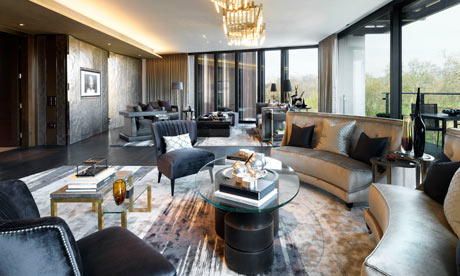
Mostly, our customers, although not without disposable income, tend not to come from the super-rich. Those who are serious about the acquisition of wealth have neither the time nor the stomach for the risks of commissioning individually designed furniture, unvalidated by the market or received opinion. Look at the pictures of the interior of One Hyde Park, designed by Lord Rogers for the Candy brothers developers and recently celebrated as the most expensive London perch at £6000 a square something or other. Luxury perhaps, but design originality no.
One Hyde Park: the cutting edge of design?
We should be grateful that our customers are people committed to individual engagement with small designers and makers, but they are not immune to the strains of the Candy-coloured economy that is enveloping us. In the
GM HQ Detroit: the lower edge of luxury?

Few now subscribe to the idea of the rising tide lifting all boats. The idea that we are distinguished by the size of our boats, but that otherwise we all bob around quite unconstrained on a pond of equal opportunity seems to me bizarre. We exist and operate in a complex network of circumstances, relationships and mutual assumptions – social, economic, political, cultural, material – that partly and unequally determines our ability to respond to changed external circumstances. One needs to examine and perhaps alter that network as well as try to influence or recognise the changes in external circumstances. Indeed the two are not actually separate.
Our work as furniture designer-makers differs not just in its individuality but in its type. Some among us produce collectable furniture, furniture without a back, furniture that might seem more comfortable on a plinth as a sculptural object than against a mundane domestic wall. Unsurprisingly, this is the furniture that gets noticed: it is within at least occasional hailing distance of that ‘unusable, unaffordable and, preferably, unmakeable’ furniture so beloved of the press and critics (and whose creators would not dream of aligning themselves with any of the restrictive categories of ‘furniture’, ‘designer’ or ‘maker’).
Indirectly, this collectable furniture benefits us all: in the minds of some of our customers it effectively validates what we do on a humbler plane. How many of us have not seen a questioner’s brow clear when they say, ‘So, your work is like so-and-so’s’, naming some more celebrated member of our ranks? Yet it is a mixed blessing: it brings us work but, unless we challenge it outright, we may find it difficult to distance ourselves far from it. We may feel we have to keep up, or at least not fall too far behind, as it moves towards ever grander plinths. It also brings some risk of squeezing out humbler work from publication, exhibition selection and so on.
Things are not helped by our collective unsureness as to what are the primary qualities that we are selling with our furniture: and the public falls back to the default option of ‘antiques of the future’. Is it an intimate relationship with wood; is it craft, design, art; or is it a ‘bespoke’ service to answer highly particular practical needs? They are all qualities that we frequently invoke, but equally they all have limitations against which we sometimes feel compelled to protest. In a crude and unrigorous survey of the catalogue to an exhibition in which I participated in 2010 I found the following frequency to some key qualities: ‘commission/bespoke’ 19, ‘unique’ 14, ‘craft’ 14, ‘design’ 12, ‘beauty’ 12, ‘wood’ 11, ‘awards/prizes’ 8, ‘heritage/generations/timeless’ 8, ‘environment/sustainability’ 6, ‘tradition’ 2. They were not always (but were mostly) the actual words used – I was surprised how often ‘beauty’ occurred. Maybe I’ve missed some: there were a few references to functionality, but no-one mentioned modern technology or its capabilities.
Is it originality and uniqueness that we aim for? It comes second in my survey and there are some very bold claims within the catalogue to the current Millinery Works exhibition, not so much to be pushing the boundaries but to be stepping right outside them. (But a severe critic might say that when we do step outside the boundaries it is more a matter of distance than new direction.) Do such claims stand up? Is that what we should be doing? The early 21st century would be an unprecedented period of cultural innovation if we were. Or are we working within and developing a broad cultural movement, as furniture-makers before us have mostly done? Are we truly developing, as the exhibition claimed, the ‘Arts and Crafts legacy’? Do we truly know what it is? 'Tradition', T.S. Eliot wrote, 'cannot be inherited, and if you want it you must obtain it by great labour.'
Eliot had much of interest to say about artistic or cultural tradition that provides a useful antidote to our tendency to regard ‘traditional’ work as simply doing what has been done before, and ‘innovative’ work as the more valuable the less it has any connection with anything that has been done before. Eliot regarded cultural tradition as something more complex and dynamic than an all-pervading ether that we inhale involuntarily. It makes little sense that art which we struggle to comprehend when new should by the simple passage of years become something that we can apprehend without effort. Eliot thought that cultural tradition could only be apprehended fully through creative or critical/appreciative effort and that, in making such an effort we do not simply repeat what has gone before, but bring our own individual variation to its realisation, so creating a living tradition and changing, to a degree, the work of the past as well as that of the present. By such changes he did not mean the kind of ‘boundary breaking’ innovation that we frequently extol, but he did recognise that a culture could at times become stultifying rather than sustaining to the individuals who shared it – ‘So positive was the culture of that age [the eighteenth century] that it crushed a number of smaller men who thought differently but could not bear to face the fact’. He recognised that, as changes in sensibility and circumstances accumulate or accelerate, a culture periodically reaches a point where artistic expression has to change decisively to maintain its functioning viability: ‘Sensibility alters in us all from age to age whether we will or no, but expression is only changed by a man of genius.’ That genius he thought lay in artistic skill, not in intensity of personal vision. In fact, perhaps for reasons peculiar to his own personality, he was intensely hostile to allowing personality any role in artistic achievement: ‘The progress of an artist is a continual self-sacrifice, a continual extinction of personality.’ He believed that any artistic expression was, by its nature, a collaborative enterprise, and he was surely right in thinking that if art is great simply according to the intensity and uniqueness of the artist’s individual vision it becomes of interest to the rest of us just as spectacle or the object of shallow emulation, precluding his concept of a creative tradition.
Arts and Crafts furniture is at least then potentially an enormous element in our cultural inheritance whether we acknowledge, ignore or reject it, but I see little evidence that we are carrying it forward in any recognisable form overall. Some pieces in an earlier exhibition that appeared at first sight to relate most to Arts and Crafts had some pretty un-Arts and Crafts construction beneath.
Yet, for a sign of our times, if one looks at the website of the Society of Designer Craftsmen, which makes much of its direct descent from Walter Crane’s and William Morris’s Arts and Crafts Exhibition Society, one finds it proclaiming ‘Innovation, originality and quality are seen as integral elements of our work…we look for people who design and make original, beautiful, exciting, challenging works…we expect members to have a strong and innovative design sense…’ I’ve added the italics to point out the particular flavour of their advocacy. I’m in favour of those qualities myself, but is there not a degree of imbalance here? (How much excitement can one take in one’s dining table?) All that reiteration comes within a few sentences. It’s not exactly how Morris would have written: Morris, Gimson, the Barnsleys and others of the Arts and Crafts movement were innovative but were also keen to draw strength from aspects of tradition. Ironically the SDC goes on to say ‘We don’t accept work that is confined within the past tradition’. It’s not quite clear what they mean by that rather tortured phrase, or whether they’re referring to their own Arts and Crafts tradition – is that only to be invoked positively when considering the society as an organisation? Is tradition an in animate object? Perhaps it’s a polite way of saying ‘reproduction’; anyway, they don’t seem to have read much Eliot, and their words are, I think, symptomatic of the way in which we now give a reductive meaning to ‘tradition’ and regard it as excluding ‘innovation’, rather than seeing the two as interactive. It is also I think a little shaming that a society, descended from nineteenth-century artists and writers who thought deeply about culture and society, should show so little evidence of serious thought about artistic tradition but opt instead for something more akin to repetitive marketing-speak.
The curators of the designer-maker exhibitions to which I refer, struggle to give us a specific, positive identity as a group (far less write us a manifesto) and fall back to ‘it may not look like a movement but….’ Is our ultimate identity only a matter of superlatives?
Collectively, we seem able to ignore scarcely any furniture-making virtue of the past 150 years: the elegance of a Ruhlmann, the robustness of a Lutyens, the truth to materials of a Barnsley, the new materials of a Breuer, the simplicity of the Shakers, the decoration of a Bugatti, the flowing curves of a Guimard, the sculptural forms of a Gaudi, the linearity of a Gray, the innovation of a Rietveld, the tradition of a … well, there I’m lost for an immediate recent exemplar. But what other quality does our work not seem to lay claim to somewhere?
Are we, in the terms of one exhibition catalogue, striving to imbue our furniture with ‘expressive existence’ or is the creative process less singly driven, so that it attains its end when it embodies a state where intellectual and emotional satisfaction are indistinguishable? A large demand on a small canvass, but I have encountered a few such pieces of furniture (including a Barnsley piece). Perhaps it is a possible defining quality of ‘applied’ art that it seeks to resolve tensions, whilst ‘fine’ art need not.
If, in search of common ground beneath all our work, we say, as this catalogue does, that ‘workmanship’ is a ‘given’, although it words and places the idea carefully, we run some risk of again reinforcing that ‘antiques of the future’ preconception; for the public is able to appreciate not so much the inherent skill which can be found unostentatiously in work of many types, but the particular expression of skill that is only possible by taking many hours: high finish, complex jointing methods and detailing, unconventional construction, extravagant forms, wide variation of materials. ‘Ah! So that’, the public thinks, ‘is why it is all so expensive.’
Is there still, in the full sense of the word, a place for ‘respectable’ furniture any more? Are we still able, in our culture, to respect something that is not innovative? If tradition has a specific, realisable meaning for us now we should be. Yet we inhabit a growth-and-progress culture which finds it almost impossible to regard embodying the future as anything but the highest virtue in a new artefact, and, although we can just about consider the possibility of cultural deficit in our obsessive contemplation of the character of each new decade, successive centuries are invariably regarded as inevitable advances, so that ‘21st-century’ glibly replaces ‘20th-century’ as a term of approbation and new hope. The hollowness of our collective cultural analysis is perhaps illustrated by the fact that, at the same time, the revered artworks of the past achieve astronomical monetary values, and, although price levels fluctuate, the work of any individual is hardly ever evicted from the financially approved canon by changes in cultural values and interests – but individual works can be admitted or removed by attribution or de-attribution almost regardless of aesthetic appeal, in something akin to financial re-engineering. It is the function of the ‘criticariat’ to translate the new, the ‘work of the future’ as rapidly as possible into the collected, valued, traded, sanctified ranks of our cultural ‘heritage’. That process is now brought to such a pitch of efficiency that it can be completed within a few years, rather than having to wait for the passing of a generation or the gradual shifting of sensibility (from future to past with minimal lingering in the present), and selected living artists simultaneously (it would seem) both challenge and embody our cultural assumptions. Eat your heart out, Van Gogh. This, in more rarefied form, is the mechanism of ‘antiques of the future’: in our case it works rather more slowly and uncertainly.
We maybe have to accept as designer-makers of furniture that we survive at the margin and sometimes in odd, though possibly moderately comfortable, niches. I hope not, but there are worse fates.
Subscribe to:
Posts (Atom)