The exhibition recreates the sophisticated world of Klimt and his patrons in Vienna around 1900 at the juncture between art, architecture and design, when this intriguing figure was at the epicentre of a cultural awakening sweeping the city. It explores the relationship between Klimt as a leader and founder of the Viennese Secession (founded 1897) and the products and philosophy of the Wiener Werkstätte (Viennese Workshop, founded 1903) – a highpoint of 20th century architecture and design. Klimt played a critical role in the Viennese Secession, a progressive group of artists and artisans driven by a desire for innovation and renewal. The work and philosophy of the Secession embraced not only art but architecture, fashion and the decorative objects and furniture of the Wiener Werkstätte, demanding the emancipation of fine and applied art in stunning environments.
Showing posts with label arts and crafts. Show all posts
Saturday, 4 February 2012
Gesamtkunstwerk
The exhibition recreates the sophisticated world of Klimt and his patrons in Vienna around 1900 at the juncture between art, architecture and design, when this intriguing figure was at the epicentre of a cultural awakening sweeping the city. It explores the relationship between Klimt as a leader and founder of the Viennese Secession (founded 1897) and the products and philosophy of the Wiener Werkstätte (Viennese Workshop, founded 1903) – a highpoint of 20th century architecture and design. Klimt played a critical role in the Viennese Secession, a progressive group of artists and artisans driven by a desire for innovation and renewal. The work and philosophy of the Secession embraced not only art but architecture, fashion and the decorative objects and furniture of the Wiener Werkstätte, demanding the emancipation of fine and applied art in stunning environments.
Friday, 8 July 2011
'Designer-maker': a problem peculiar to furniture?
The draft of some reflections on this topic, prompted by a reading of Peter Dormer's The Art of the Maker (1994) and The New Furniture (1987) can be found on the Talks and Articles page of this blog.
Thursday, 28 April 2011
Ruins, ancient and modern
In a recent newspaper comment article, Simon Jenkins, former trustee of the Architecture Foundation, former deputy chairman of English Heritage, current chairman of the National Trust, deplored the English ‘cult of the ruin’, which leads us to the antiseptic preservation of historical ruins, where close cropped ‘nationalised grass’ stops three inches short of the stabilised masonry – a description many will instantly recognise as characteristic of English Heritage’s wind-swept ruined choirs – whilst we dutifully reject any attempt to put our historic derelicts to any active use or, yet worse to some minds, ‘restore’ and rebuild them as the Victorians might unhesitatingly have done.
As in so many of our present cultural problems, the Victorians provide precedents for both the malaise and the solution. Simon Jenkins might have cited the Society for the Protection of Ancient Buildings as a guide to a humane solution. Founded in 1877 by William Morris and other members of the Pre-Raphaelite Brotherhood to oppose Victorian restoration of historic buildings to a supposed (and often spurious) ‘authentic’ state in which they were thought to have existed at some arbitrarily chosen point in their history, the society, in the spirit of ‘anti scrape’, campaigned against the destruction of those accretions of physical adaptions and maturings that embodied the history of the human use of the building over the course of its existence – the patina of buildings, one might say. It believed historic buildings should be kept in good repair, put to sympathetic use, and physically adapted if necessary, but that any additions should be frankly modern and not attempt to disguise the distinction between the new and the old. Protection, not preservation.
In this, as in his concern for the state of manufacturing, and especially for the condition of furniture making that was expressed in the Arts and Crafts movement, Morris, like Ruskin and other like-minded contemporaries, emphasised the human, not just the aesthetic aspect of the culture, art and craft of their time.
The SPAB continues to this day, still requiring each member to subscribe to Morris’s original manifesto, though at times it may seem that the humaneness of the society faces a tidal wave of professional and commercially motivated restoration experts and materials suppliers. Yet it perhaps preserves the original spirit of its foundation better than that other survival of Morris’s efforts, the Arts and Crafts Exhibition Society, which has renamed itself the Society of Designer Craftsmen, and about which I have commented somewhat critically in an earlier post.
As for that other English institution over which Simon Jenkins holds some sway, the National Trust, it too was founded, at the close of the nineteenth century, by people whose concern was for the well-being of people in the physical and cultural landscape, and, as such, they were the successors of Morris and his socialist-minded contemporaries. It was only in the mid-twentieth century that the Trust began to devote so much of its energies to the preservation of the English country house, with which it has come to be so much associated in the public mind. That effort, in its own way, also laid much emphasis on the preservation not only of the buildings but of the material and detritus that embodied the lives of their past occupants, regardless of high aesthetic merit – everything from the Rubens to the elephant’s foot umbrella stand. A corollary of that was the desirability of maintaining the occupants in residence where possible, even if in reduced domain – something that was, we are told, later to lead on occasion to friction between the ‘owners’ and the Trust’s professional advisors and staff. Nevertheless, on another level the contextualised preservation of the art of the past, the only realm in which the cash-strapped post-war English could compete with the purchasing power of American and other foreign public and private art buyers, did achieve remarkable professional cultural and commercial success in opposition to the isolated, anaesthetised presentation of the cultural object in a museum environment – the cult, if not of the ruin, at least of the artefact.
For the masses, for whose benefit the Trust was originally established, this country-house culture came to be expressed in the ticketed-entry, exit-through-the-gift-shop ethos – a far cry from the cultural and social concerns of the young fogeys who had ‘saved’ the country house, but an essential prop to the political and commercial well-being of the Trust today.
In our own little realm of furniture making, we have an interesting conjunction of the historic and the modern in the Worshipful Company of Furniture Makers, an association active in the affairs of the industry at every level including that of the small designer-maker and bestowers of the Guildmark, something about which I have commented in a few posts on this blog. This ancient sounding company was founded in the 1950s with full subscription to the arcane trappings of the City of London Livery Company – an relationship that such groups in modern economic life as public relations practitioners, international bankers, tax advisers, management consultants and security professionals have, in recent years, been anxious to establish. Move over, cordwainers and tallow chandlers.
Wednesday, 6 April 2011
Pivot point
Garlic and sapphires in the mud
Clot the bedded axel-tree.
Recently a fellow furniture designer-maker commended another’s account of the development of our work for knowing ‘which pieces were pivotal’. Whilst I don’t want to dispute the ability of either of them to know what work is genuinely remarkable, I do query whether there is anything so specific, in the collective body of the current work of small furniture designer-makers, as a pivot, or whether we are actually aware of our work turning on (or ignoring) any key development.
We are in fact remarkably ill informed of what the rest of us are currently up to. Our work lacks a mode of publication and a nexus of sociability. We have the misfortune that our product is of sufficient substance to make it difficult for us to move around (we are unlikely to up sticks on a whim and go off to make furniture with our fellows in the south of France), but not of enough substance to make it impossible to ignore as hundreds troop by it on their way to work. It is insufficiently artistic, insufficiently valuable, insufficiently new to be much remarked by critics and commentators. It is too expensive to matter much to the masses. The old network of patronage that used to advance fashions in interior taste has passed away, and those who come closest nowadays to setting public taste or fashion often do so without much commissioning or patronising the work themselves.
So how is new work communicated, even amongst ourselves? We might expect to see our fellows’ work at exhibitions, but furniture exhibitions are in notoriously short supply, unprofitable for their organisers and not always well supported by exhibitors with their best and newest work. Nearly all of us have websites, but few are good at updating them with their latest work. We could in fact quite easily do more than we do to communicate our newest ideas and designs: our association could easily – but does not – have a place in the members’ section of its website specifically for such communication.
I believe we don’t do more to communicate our latest work because we do not want to. We do not want to partly for our own reasons of ‘commercial confidentiality’ (I have more often seen members fret about plagiarism than enthuse that others are developing similar ideas to their own), and partly because we simply do not have much in the way of ideas to communicate.
Having claimed that our work collectively lacks particular direction or sense of purpose, I will now contradict myself (up to a point) by trying to identify some common elements in the most noticed furniture.
One recently discernible is the creation, almost the imposition of textured effects on timber surfaces. Pieces of furniture with this characteristic have been the leading items in several recent group exhibitions in London associated with DMOU. Sometimes, not always, rather than exploiting texture inherent in the material, the surface effects are created with techniques similar to those needed to produce the dead-smooth, high-finish surfaces of the ‘I can’t believe it’s not plastic’ type that many have come inescapably to associate with expensive ‘bespoke’ furniture. Sometimes in these pieces, also, the surface texture is the focus to the noticeable neglect of interest in underlying form.
In that respect it may possibly be a parallel to Martin Grierson’s belief that ‘the success and beauty of a design lie as much in the quality of detail and choice of materials as in the overall concept’. I don’t entirely disagree with that, but I do think it may beg the question whether there is a stable and mature vocabulary of form on which the designer-maker draws. Yet perhaps that is what Martin encompasses in his reference to ‘proper pieces of furniture that exploit traditional forms’.
So, if that is the garlic, where are the sapphires? Elsewhere in these London exhibitions an interest in differentiation by conspicuous form still thrives, with, sometimes, a virtuoso predilection for forms that dramatically challenge methods of timber construction and making ability. A delight in pushing things to extremes – in construction, detailing, refinement, and, in consequence, probably cost – has something to be said for it, and something against. It could be seen as part of the overloading of our culture with a multitude of signs. It can hardly form the basis for a movement – flux perhaps but not a movement in any direction. It cannot be that ‘pivot point’ we seek.
It is, however, what frequently receives the prizes and guildmarks for ‘bespoke’ furniture, although, ironically, the particular pieces that receive these accolades are sometimes not bespoken at all but are instead deliberate speculative punts at awards by designer-makers, and, even so decorated, they may struggle to find purchasers thereafter.
Whether any of this can amount to a continuation of the Arts and Crafts ‘legacy’ (the theme of these exhibitions), beyond a degree of self-regard in our work as furniture designer-makers, I personally doubt. It certainly does not constitute ‘wonderful furniture of a commonplace kind’, to use Ernest Gimson’s description of WR Lethaby’s furniture in the 1890 Arts and Crafts exhibition.
What exactly is meant by that phrase is a little problematic. It perhaps applies more to Gimson’s work than Lethaby’s. Lethaby did not actually design much furniture (or architecture come to that) and some of it might not universally be regarded as commonplace. Nor is it without decoration. But perhaps this is a subject to which I might return.
Clot the bedded axel-tree.
Recently a fellow furniture designer-maker commended another’s account of the development of our work for knowing ‘which pieces were pivotal’. Whilst I don’t want to dispute the ability of either of them to know what work is genuinely remarkable, I do query whether there is anything so specific, in the collective body of the current work of small furniture designer-makers, as a pivot, or whether we are actually aware of our work turning on (or ignoring) any key development.
We are in fact remarkably ill informed of what the rest of us are currently up to. Our work lacks a mode of publication and a nexus of sociability. We have the misfortune that our product is of sufficient substance to make it difficult for us to move around (we are unlikely to up sticks on a whim and go off to make furniture with our fellows in the south of France), but not of enough substance to make it impossible to ignore as hundreds troop by it on their way to work. It is insufficiently artistic, insufficiently valuable, insufficiently new to be much remarked by critics and commentators. It is too expensive to matter much to the masses. The old network of patronage that used to advance fashions in interior taste has passed away, and those who come closest nowadays to setting public taste or fashion often do so without much commissioning or patronising the work themselves.
So how is new work communicated, even amongst ourselves? We might expect to see our fellows’ work at exhibitions, but furniture exhibitions are in notoriously short supply, unprofitable for their organisers and not always well supported by exhibitors with their best and newest work. Nearly all of us have websites, but few are good at updating them with their latest work. We could in fact quite easily do more than we do to communicate our newest ideas and designs: our association could easily – but does not – have a place in the members’ section of its website specifically for such communication.
I believe we don’t do more to communicate our latest work because we do not want to. We do not want to partly for our own reasons of ‘commercial confidentiality’ (I have more often seen members fret about plagiarism than enthuse that others are developing similar ideas to their own), and partly because we simply do not have much in the way of ideas to communicate.
Having claimed that our work collectively lacks particular direction or sense of purpose, I will now contradict myself (up to a point) by trying to identify some common elements in the most noticed furniture.
One recently discernible is the creation, almost the imposition of textured effects on timber surfaces. Pieces of furniture with this characteristic have been the leading items in several recent group exhibitions in London associated with DMOU. Sometimes, not always, rather than exploiting texture inherent in the material, the surface effects are created with techniques similar to those needed to produce the dead-smooth, high-finish surfaces of the ‘I can’t believe it’s not plastic’ type that many have come inescapably to associate with expensive ‘bespoke’ furniture. Sometimes in these pieces, also, the surface texture is the focus to the noticeable neglect of interest in underlying form.
In that respect it may possibly be a parallel to Martin Grierson’s belief that ‘the success and beauty of a design lie as much in the quality of detail and choice of materials as in the overall concept’. I don’t entirely disagree with that, but I do think it may beg the question whether there is a stable and mature vocabulary of form on which the designer-maker draws. Yet perhaps that is what Martin encompasses in his reference to ‘proper pieces of furniture that exploit traditional forms’.
So, if that is the garlic, where are the sapphires? Elsewhere in these London exhibitions an interest in differentiation by conspicuous form still thrives, with, sometimes, a virtuoso predilection for forms that dramatically challenge methods of timber construction and making ability. A delight in pushing things to extremes – in construction, detailing, refinement, and, in consequence, probably cost – has something to be said for it, and something against. It could be seen as part of the overloading of our culture with a multitude of signs. It can hardly form the basis for a movement – flux perhaps but not a movement in any direction. It cannot be that ‘pivot point’ we seek.
It is, however, what frequently receives the prizes and guildmarks for ‘bespoke’ furniture, although, ironically, the particular pieces that receive these accolades are sometimes not bespoken at all but are instead deliberate speculative punts at awards by designer-makers, and, even so decorated, they may struggle to find purchasers thereafter.
Whether any of this can amount to a continuation of the Arts and Crafts ‘legacy’ (the theme of these exhibitions), beyond a degree of self-regard in our work as furniture designer-makers, I personally doubt. It certainly does not constitute ‘wonderful furniture of a commonplace kind’, to use Ernest Gimson’s description of WR Lethaby’s furniture in the 1890 Arts and Crafts exhibition.
What exactly is meant by that phrase is a little problematic. It perhaps applies more to Gimson’s work than Lethaby’s. Lethaby did not actually design much furniture (or architecture come to that) and some of it might not universally be regarded as commonplace. Nor is it without decoration. But perhaps this is a subject to which I might return.
Labels:
arts and crafts,
designer-makers,
DMOU,
Ernest Gimson,
exhibitions,
furniture,
Guildmark,
T S Eliot,
W R Lethaby
Saturday, 2 April 2011
Where are we in the world?
I recently initiated a thread on the furniture designer-makers forum to which I subscribe trying to identify our place in the wider social and economic currents swirling around us. This, I suppose, was the heart of it:
It can hardly be denied that 'We make expensive objects that few can afford'; that even our batch produced furniture needs a more than average level of disposable income; and that many of us are uncomfortable with that - just as William Morris was all that time ago.
Long ago our society and economy got to the point where no ordinary person could afford the fruits of 'hand production', except for very small items and the repair of important technologically produced goods, like fixing our cars. Yet even there the range of those mass produced items that it is 'economic' to repair by individual labour rather than just buy a new one is, as we all notice, shrinking rapidly, and many are explicitly manufactured in a way that means it is impossible to take them apart without destroying them. (How many of us incidentally have any concern for the possibility of taking our furniture apart non-destructively in decades to come?)
And things have moved on, so that here most people cannot afford even mass-produced objects unless the relatively low labour content they still require comes from third-world workers, whom we regard with an uncomfortable mixture of guilt that we are exploiting them, and moral self-approbation that we are 'lifting them out of poverty'. (Never mind that we are also lifting them out of their own cultures, and we usually put aside the thought that once we have so lifted them the added burden on the world's resources will become truly insupportable.)
And things are moving on still further, so that the globalised economy is moving towards an end where generally labour will be unable to earn sufficient money to purchase its own product and wealth becomes increasingly invested in assets of inflating value rather than in productive industry. This is, as far as I understand it, the collapse of our economy that some people predict through a combination of simultaneous inflation in one area and deflation in another.
The one indispensible item for us all where a relatively high element of hand labour is difficult to eliminate or outsource to the third world is our houses, which have inflated to a value where they become a life-time burden on our personal earnings and a key asset prop of the whole unstable financial/economic system, ripe (or over-ripe) for corruption by those who believe they can manipulate the system for their own advantage.
My point is that, however morally aware and troubled we are, it is a difficult treadmill to step off.
You are right too that we attach tags to our furniture to redeem it. 'Green' is one of the most common, but some time ago Barnaby pointed out that the carbon footprint of a small workshop was likely to compare very unfavourably with that of larger production. So we concentrate on how sustainably we source our raw materials and gloss over the sustainability of our whole operation, let alone the fact that a large proportion of our sustainable timber ends up in the dust extractor.
'Heirloom' is perhaps safer if we just mean that we expect our furniture to out-last us and we hope it will still be valued by succeeding generations. Yet we have to steer clear of meaning 'value' in any monetary sense, because when our furniture does reach the resale market it commands pretty miserable prices, and, in the 'antique' market generally it is only a very few outstanding and 'collectible' items that attract high prices, and the vast bulk of well designed and made furniture from the past sells for low prices in the sense that no-one today could possibly make it from scratch so cheaply.
That is a reflection of the nature of the asset market that characterises the wealthiest end of our society and economy, and what is, I think, most ethically uncomfortable for us as designer-makers is a tendency to aspire in our work to the trappings of that level of luxury. Mostly the hope is vain, but it results in very expensive furniture with a very high level of finish and a sophistication verging on the absurd, a rarified claim to be taking our product to unprecedented, never before thought of heights. (And here we break ranks with our Arts and Crafts predecessors.) That sort of approach of course finds willing allies in the ranks of professional marketers and promoters, publicists and even 'critics', and maybe associations. It is inimical to any more culturally distinct or articulated characterisation of a body of craft or art work. Historically, work that has been so characterised has often met, initially, with surprise, incomprehension or hostility from the contemporary market - which is not what our new association is aiming at.
It can hardly be denied that 'We make expensive objects that few can afford'; that even our batch produced furniture needs a more than average level of disposable income; and that many of us are uncomfortable with that - just as William Morris was all that time ago.
Long ago our society and economy got to the point where no ordinary person could afford the fruits of 'hand production', except for very small items and the repair of important technologically produced goods, like fixing our cars. Yet even there the range of those mass produced items that it is 'economic' to repair by individual labour rather than just buy a new one is, as we all notice, shrinking rapidly, and many are explicitly manufactured in a way that means it is impossible to take them apart without destroying them. (How many of us incidentally have any concern for the possibility of taking our furniture apart non-destructively in decades to come?)
And things have moved on, so that here most people cannot afford even mass-produced objects unless the relatively low labour content they still require comes from third-world workers, whom we regard with an uncomfortable mixture of guilt that we are exploiting them, and moral self-approbation that we are 'lifting them out of poverty'. (Never mind that we are also lifting them out of their own cultures, and we usually put aside the thought that once we have so lifted them the added burden on the world's resources will become truly insupportable.)
And things are moving on still further, so that the globalised economy is moving towards an end where generally labour will be unable to earn sufficient money to purchase its own product and wealth becomes increasingly invested in assets of inflating value rather than in productive industry. This is, as far as I understand it, the collapse of our economy that some people predict through a combination of simultaneous inflation in one area and deflation in another.
The one indispensible item for us all where a relatively high element of hand labour is difficult to eliminate or outsource to the third world is our houses, which have inflated to a value where they become a life-time burden on our personal earnings and a key asset prop of the whole unstable financial/economic system, ripe (or over-ripe) for corruption by those who believe they can manipulate the system for their own advantage.
My point is that, however morally aware and troubled we are, it is a difficult treadmill to step off.
You are right too that we attach tags to our furniture to redeem it. 'Green' is one of the most common, but some time ago Barnaby pointed out that the carbon footprint of a small workshop was likely to compare very unfavourably with that of larger production. So we concentrate on how sustainably we source our raw materials and gloss over the sustainability of our whole operation, let alone the fact that a large proportion of our sustainable timber ends up in the dust extractor.
'Heirloom' is perhaps safer if we just mean that we expect our furniture to out-last us and we hope it will still be valued by succeeding generations. Yet we have to steer clear of meaning 'value' in any monetary sense, because when our furniture does reach the resale market it commands pretty miserable prices, and, in the 'antique' market generally it is only a very few outstanding and 'collectible' items that attract high prices, and the vast bulk of well designed and made furniture from the past sells for low prices in the sense that no-one today could possibly make it from scratch so cheaply.
That is a reflection of the nature of the asset market that characterises the wealthiest end of our society and economy, and what is, I think, most ethically uncomfortable for us as designer-makers is a tendency to aspire in our work to the trappings of that level of luxury. Mostly the hope is vain, but it results in very expensive furniture with a very high level of finish and a sophistication verging on the absurd, a rarified claim to be taking our product to unprecedented, never before thought of heights. (And here we break ranks with our Arts and Crafts predecessors.) That sort of approach of course finds willing allies in the ranks of professional marketers and promoters, publicists and even 'critics', and maybe associations. It is inimical to any more culturally distinct or articulated characterisation of a body of craft or art work. Historically, work that has been so characterised has often met, initially, with surprise, incomprehension or hostility from the contemporary market - which is not what our new association is aiming at.
Labels:
arts and crafts,
associations,
change,
DMOU,
economics,
FDMA,
furniture,
globalisation,
luxury
Hand or Machine?
'Manufacture': literally, to make by hand.
The question whether hand work is somehow superior to machine work is s an old one that takes us straight back to our supposed Arts and Crafts roots. When John Ruskin and William Morris first objected to the Victorian mechanisation of manufacture their primary concern was for the spiritual wellbeing of the craftsman; the quality of the artefact was secondary in their minds.
Today we have almost completely lost that concern, although there is an interesting echo when we say that some more primitive methods are so tedious that the maker is unlikely to indulge in a second attempt to improve a poor initial result. There, in some sense, one is referencing Morris’s recognition that machinery could legitimately relieve the workman of unhealthy drudgery, but I’m not sure that either he or Ruskin would have welcomed the idea that the artefact is to be perfected by multiple mechanised attempts. That’s not how they built the cathedrals, as anyone can still see.
It was in this context that the Arts and Crafts objected to ‘applied decoration’: they were very far, at least initially, from objecting to ornamentation as such, and for Ruskin it was a vital expression of the spiritual content of craft.
The primary concern of Ruskin and Morris was that the craftsperson should be engaged in and should delight in the process of the making of the object from start to finish – the autonomy of craft. So hand versus machine is not a simple issue. Yet machines do inevitably tend towards a division of labour, no less in our time than the Victorian, as we (some of us) commission the computerised subcontractor for some highly specialised element of our sophisticated design.
Nor is excessive finish and unwelcome physical uniformity in furniture or any other artefact necessarily the product of the maximum utilisation of available mechanical processes. To a considerable degree, ‘craft’ making skill in our time has come to be identified with the achievement of levels of accuracy that the public might think cold normally be achieved only by machines. That may be a vulgar misperception but it is nevertheless something that designer-makers have done and continue to do a great deal to encourage. And we start to feel either uncomfortable or exhilarated as highly mechanised and automated production begins to achieve a level of individualised design that previously was associated only with small-scale ‘hand’ production.
It calls into question the whole aesthetic of the modern movement, that still holds surprising residual sway, that function could determine form without the intervention of taste or style, that there was, somehow, a styleless modern style that would be ushered in by the inevitable mechanisation of production.
Machines and tools exist in a continuum, and skill is not to be counterbalanced against them. Indeed the exercise of skill, in the context of making artefacts, is hardly possible at all without the utilisation of tools or machines. Yet there is an inescapable paradox that tools at the same time enable skills and achieve ‘deskilling’. The difficulty arises when and to the extent that the tool or machine operates without the agency of the person – though in our own context of ‘computer controlled’ (what exactly do we mean by that phrase?) machinery it is not always as easy as it might seem to say when that point is reached.
Lethaby, one of the progenitors of the Arts and Crafts as a movement, urged that craftspeople should produce good designs specifically for machine manufacture. Ernest Gimson always resisted Lethaby’s personal urgings, arguing that the mechanically produced version of his design work would drive out, commercially and culturally, the hand production that resulted in something superior at a higher cost. Both, in their different ways, had to a considerable extent abandoned Ruskin’s and Morris’s struggle with the personal cultural and spiritual problem of their (and our) day, and we now seem no closer to re-engaging with it.
Perhaps, as our national economy increasingly outsources to developing countries not just all physical production but also ‘mind-based’ work, it has come to be seen as a lost battle or an irrelevance.
The question whether hand work is somehow superior to machine work is s an old one that takes us straight back to our supposed Arts and Crafts roots. When John Ruskin and William Morris first objected to the Victorian mechanisation of manufacture their primary concern was for the spiritual wellbeing of the craftsman; the quality of the artefact was secondary in their minds.
Today we have almost completely lost that concern, although there is an interesting echo when we say that some more primitive methods are so tedious that the maker is unlikely to indulge in a second attempt to improve a poor initial result. There, in some sense, one is referencing Morris’s recognition that machinery could legitimately relieve the workman of unhealthy drudgery, but I’m not sure that either he or Ruskin would have welcomed the idea that the artefact is to be perfected by multiple mechanised attempts. That’s not how they built the cathedrals, as anyone can still see.
It was in this context that the Arts and Crafts objected to ‘applied decoration’: they were very far, at least initially, from objecting to ornamentation as such, and for Ruskin it was a vital expression of the spiritual content of craft.
The primary concern of Ruskin and Morris was that the craftsperson should be engaged in and should delight in the process of the making of the object from start to finish – the autonomy of craft. So hand versus machine is not a simple issue. Yet machines do inevitably tend towards a division of labour, no less in our time than the Victorian, as we (some of us) commission the computerised subcontractor for some highly specialised element of our sophisticated design.
Nor is excessive finish and unwelcome physical uniformity in furniture or any other artefact necessarily the product of the maximum utilisation of available mechanical processes. To a considerable degree, ‘craft’ making skill in our time has come to be identified with the achievement of levels of accuracy that the public might think cold normally be achieved only by machines. That may be a vulgar misperception but it is nevertheless something that designer-makers have done and continue to do a great deal to encourage. And we start to feel either uncomfortable or exhilarated as highly mechanised and automated production begins to achieve a level of individualised design that previously was associated only with small-scale ‘hand’ production.
It calls into question the whole aesthetic of the modern movement, that still holds surprising residual sway, that function could determine form without the intervention of taste or style, that there was, somehow, a styleless modern style that would be ushered in by the inevitable mechanisation of production.
Machines and tools exist in a continuum, and skill is not to be counterbalanced against them. Indeed the exercise of skill, in the context of making artefacts, is hardly possible at all without the utilisation of tools or machines. Yet there is an inescapable paradox that tools at the same time enable skills and achieve ‘deskilling’. The difficulty arises when and to the extent that the tool or machine operates without the agency of the person – though in our own context of ‘computer controlled’ (what exactly do we mean by that phrase?) machinery it is not always as easy as it might seem to say when that point is reached.
Lethaby, one of the progenitors of the Arts and Crafts as a movement, urged that craftspeople should produce good designs specifically for machine manufacture. Ernest Gimson always resisted Lethaby’s personal urgings, arguing that the mechanically produced version of his design work would drive out, commercially and culturally, the hand production that resulted in something superior at a higher cost. Both, in their different ways, had to a considerable extent abandoned Ruskin’s and Morris’s struggle with the personal cultural and spiritual problem of their (and our) day, and we now seem no closer to re-engaging with it.
Perhaps, as our national economy increasingly outsources to developing countries not just all physical production but also ‘mind-based’ work, it has come to be seen as a lost battle or an irrelevance.
Tuesday, 22 March 2011
Current Exhibition: 21st Century Furniture III
The Arts & Crafts Legacy
A Selling Exhibition of Today's Designer Makers
I am currently participating in this exhibition, which has now become an annual event.
A Selling Exhibition of Today's Designer Makers
I am currently participating in this exhibition, which has now become an annual event.
What is it that we do when, as ‘designer-makers’ we make a table? What, through the table, do we seek to exhibit? Why do we define our exhibition by reference to furniture-makers in small workshops, in the southern English countryside a century ago, producing ‘wonderful furniture of a commonplace kind’? ‘Art’ and ‘Craft’ are labels that now we are comfortable neither to abandon nor wholeheartedly adopt. ‘Designer’, though now fading from its recent almost universally positive currency, was an offspring of Arts and Crafts through a Balhausian intermediary, where it acquired its renunciation of ornament. Ornament, not universally eschewed by the Arts and Crafts makers, troubles us still. Now that we can make in so many ways (the kind of technical virtuosity that got the Victorians into trouble) we are tempted (as always following the architects) to differentiate our work through form, which can sometimes be as much ‘applied’ as the decoration of the Victorians. Such thoughts are pursued elsewhere on this blog.
The Millinery Works
85/87 Southgate Road
Islington
London N1 3JS
020 7359 2019
20 March to 1 May 2011
closed Mondays and Easter
further details at http://www.millineryworks.co.uk/
Is it Art?
A furniture maker's lament
We furniture designer-makers are much exercised by contemplation of the nature of what we do (as this blog may demonstrate). We start from the recognition, often very reluctant, that it is certainly ‘craft’. We quickly add that it is also ‘design’. Since the 1960s ‘design’ has had almost totally positive connotations. (In 1960 the Arts and Crafts Exhibition Society, founded in the 1880s by Walter Crane, William Morris and others, thought it wise to change its name to the Society of Designer Craftsmen – gender politics seemed of less concern.) So we are ‘designer-makers’, thus distinguishing ourselves from those craftspeople who ‘think’ only to the extent of considering the precision of their joints, who read popular amateur craft magazines, and who have a distressing tendency to sell their work in village halls. Yes, we are certainly designers.
Yet, half a century on, the attractions of being a designer have worn rather thin. Those Bauhausian certainties may still work if you are producing a revolutionary new hand drier, but if it’s another expensive table they don’t seem to achieve the high prices and glittering press to which we aspire. What we would really like to be is artists, working in studios, showing in proper galleries; not the Crafts Council (ironically universally despised for jilting craft for art) but the Arts Council.
Or rather, we would like to create ‘art’ (taking our cue from T.S. Eliot’s sniffy response to the young man seeking his advice on how to become a poet, that he could not understand anyone wanting to be a poet, although he could understand someone wanting to write poems).
Is what we do ‘art’? That is not an easy question to answer unless we can say what art is, and people seldom venture a definition of art except as a stepping stone en route to arguing a further point. But such light footwork leaves the foundation of any claim shaky and we would be best to think a little about the nature of art outside our own activities before laying any claim.
What is it then that I do when I hang a painting of, say, a seascape on my wall? (A bizarre and useless thing to do.) What is the intention of art?
At the most workaday level one might say that the painting extends the viewer’s experience: shows them something they haven’t seen before. That seems a little inadequate, at least in the visual arts, which must be one of our closest desired fine arts bedfellows, although in narrative literature there is much, past and present, that feels no need to stake a higher claim to justify itself as art. But let us look beyond.
My seascape, Dutch master or Turner, may change the way in which I perceive the sea, not just the sea it portrays, but all sea. It changes my sensibility, changes my perception of the world: indeed great art may change the way I see everything, whatever the picture portrays, or does not.
It would be possible to argue that all fine art, even abstract art, is representational, or perhaps less contentious to say that all fine art centrally references something outside itself. That art achieves universality by being not self contained. Until one comes to Malevich’s painting in 1913 of a white square on a white ground, by which he looked to create purity of feeling, and Mondrian’s work a few years later, in which he aimed not at purity of sensation but purity of being, and thought that only by confining himself to right angles could he achieve it.
Somewhere here is our first problem as furniture designer-makers and would-be artists. It is not just that we start with (more or less) useful objects. When I design and make a chair I do not make a representation of a chair (or a locus of pure feeling or pure being), I make a chair itself. If I argue that my artistic enterprise is the representation of some ideal notion of a chair, I don’t really convince myself. People might also wonder why I confine myself to the more or less realistic representation of furniture, and whether I should not be relegated to a similarly lowly status in the artistic hierarchy as botanical artists and pet portraitists.
Yet, putting those worries aside, can I design and make furniture that changes the way people perceive a chair, or a table, if not the world?
Some designer makers have produced items that, one might say, do exactly that: in appearance or actuality challenging our assumptions of the qualities essential for a furniture type. A table is an elevated, stable, flat, horizontal surface, but Ian Spencer’s table gives the impression that as soon as you placed a feather on it all its end-grain components would drop to the floor in pixelated disintegration. Michael Wainwright’s Mutagen table bristles with spiky little growths that would make placing one’s floral arrangement and family photographs a little difficult.
Yet these pieces shake up one’s assumptions, rather like the child’s snow-storm toy, only to let them settle back in the old form, leaving us with a more vivid realisation that a table is an elevated, stable, flat, horizontal surface after all. Look, Ian Spencer is leaning on his table, it doesn’t fall apart. Striking though the furniture is, this approach, conceptually, seems rather a one-card trick.
Rather different is Gareth Neal’s ‘Cut and Groove’ series, where his Anne console table has a Queen Anne design appearing inside the ghostly slotted outline of a modernist table. It is undeniably striking, but neither design, considered on its own, has particular merit. It is the coincidence of the two, historically different idioms that gains the effect – and distracts us from considering the complete domestic impracticality of the piece. If one were to use the same concept with the historically anachronistic design as one element would it have the same effect? Once again, this seems something of a visual trick – original certainly; but is it transformational, capable of generating a new line of work, a recreation of tradition (it relies on notions of tradition for its effect)? I think not.
Perhaps we should look more to those designer-makers who avowedly aim to extend the range of expectation that people might entertain for a table, a chair. We didn’t think a table could look like this, we gasp in surprise and admiration. Is this art? Up to a point perhaps, but when Cézanne painted Mont Sainte-Victoire he wasn’t showing us a new kind of mountain. In fact, without Cézanne, it’s a rather ordinary sort of mountain. He was changing the way in which we perceive all mountains, perhaps all nature, all masses. The table extends our perceptions cumulatively; the painting does so transformationally. There may be (though there probably aren’t) limitless ways in which to make a table, and, once shown, they are all accessible to us. There certainly are limitless ways in which to perceive the mountain, but they are not all accessible to us: it takes the artist (what Eliot would call the man of genius) to show us how. If there were such a thing as an Aztec table we could probably create our own table in its spirit; but an Aztec figure carving, or an Ife head, though they move us, are not fully apprehendable for us. Their culture is no longer fully accessible to us.
So where next, in our search for greater cultural ’bottom’ to our work? Perhaps we should follow the architects: after all there never was one who didn’t think they could design furniture regardless of an ignorance of how it could be made. Yet they have an unfair advantage of scale over us. You can get inside their creations (even though the roof may leak). Getting inside a wardrobe doesn’t normally offer the same opportunities for the appreciation of spatial organisation as standing at the bottom of the staircase in the new Ashmoleum.
Architecture is of course, apart from sometimes incidental decoration, an abstract art, and it is interesting to reflect that, long before the prevalence of the abstract in modern western fine art, there was a historical period when art was not only abstract but there was an absolute prohibition on representation. ‘Thou shalt not make to thyself any graven image, not the likeness of anything that is in heaven above, nor in the earth beneath, or in the water under the earth.’ One can further observe that the non-representational art that prevailed and achieved enormous sophistication in the east over a period of seven hundred years and spread its influence west was a decorative art. Over seven centuries it manifested no growth or development beyond the refinement of perfected formulae. Remarking on that, Ruskin concluded that abstract art, if long pursued leads to the destruction of both intellectual powers and moral principle. Mondrian apparently disproves him on both counts, but the relationship of the abstract and the decorative in non-representational art requires considerable discrimination.
However that may be, because of the limitation of scale and complexity in furniture, we are often tempted into decoration to give added interest or greater perceived value to our work. There is some hypocrisy in the prevailing design animus towards decoration. Even engineering-based designers are often deeply concerned with the cosmetic properties of their product, claim as they may to eschew decoration as such. The Arts and Crafts furniture makers were not opposed to decoration. Much of their work, as well as the historical exemplars they admired, is rich in applied decoration. Decoration can be an aid to spatial articulation and differentiation.
An architectural critic, who, writing of a church by the seventeenth-century master-builder Francesco Borromini, observed: ‘The effect of prolonged contemplation of this interior goes beyond logic: it produces a mental tension, an excitement, in which – as in a flowing piece of counterpoint by a great composer – everything fits miraculously together and it is impossible to separate intellectual from emotional pleasure.’ If we could achieve that we need not bother whether it is craft, design or art.
Perhaps, after all, we should be content as ’makers’, aspiring, like Eliot, to learn from and to be ‘il miglio fabbro’. (Isn’t all the best furniture Italian?) At the beginning God made heaven and earth: he didn’t feel obliged to explain that it was design – or art.
We furniture designer-makers are much exercised by contemplation of the nature of what we do (as this blog may demonstrate). We start from the recognition, often very reluctant, that it is certainly ‘craft’. We quickly add that it is also ‘design’. Since the 1960s ‘design’ has had almost totally positive connotations. (In 1960 the Arts and Crafts Exhibition Society, founded in the 1880s by Walter Crane, William Morris and others, thought it wise to change its name to the Society of Designer Craftsmen – gender politics seemed of less concern.) So we are ‘designer-makers’, thus distinguishing ourselves from those craftspeople who ‘think’ only to the extent of considering the precision of their joints, who read popular amateur craft magazines, and who have a distressing tendency to sell their work in village halls. Yes, we are certainly designers.
Yet, half a century on, the attractions of being a designer have worn rather thin. Those Bauhausian certainties may still work if you are producing a revolutionary new hand drier, but if it’s another expensive table they don’t seem to achieve the high prices and glittering press to which we aspire. What we would really like to be is artists, working in studios, showing in proper galleries; not the Crafts Council (ironically universally despised for jilting craft for art) but the Arts Council.
Or rather, we would like to create ‘art’ (taking our cue from T.S. Eliot’s sniffy response to the young man seeking his advice on how to become a poet, that he could not understand anyone wanting to be a poet, although he could understand someone wanting to write poems).
Is what we do ‘art’? That is not an easy question to answer unless we can say what art is, and people seldom venture a definition of art except as a stepping stone en route to arguing a further point. But such light footwork leaves the foundation of any claim shaky and we would be best to think a little about the nature of art outside our own activities before laying any claim.
What is it then that I do when I hang a painting of, say, a seascape on my wall? (A bizarre and useless thing to do.) What is the intention of art?
At the most workaday level one might say that the painting extends the viewer’s experience: shows them something they haven’t seen before. That seems a little inadequate, at least in the visual arts, which must be one of our closest desired fine arts bedfellows, although in narrative literature there is much, past and present, that feels no need to stake a higher claim to justify itself as art. But let us look beyond.
My seascape, Dutch master or Turner, may change the way in which I perceive the sea, not just the sea it portrays, but all sea. It changes my sensibility, changes my perception of the world: indeed great art may change the way I see everything, whatever the picture portrays, or does not.
It would be possible to argue that all fine art, even abstract art, is representational, or perhaps less contentious to say that all fine art centrally references something outside itself. That art achieves universality by being not self contained. Until one comes to Malevich’s painting in 1913 of a white square on a white ground, by which he looked to create purity of feeling, and Mondrian’s work a few years later, in which he aimed not at purity of sensation but purity of being, and thought that only by confining himself to right angles could he achieve it.
Somewhere here is our first problem as furniture designer-makers and would-be artists. It is not just that we start with (more or less) useful objects. When I design and make a chair I do not make a representation of a chair (or a locus of pure feeling or pure being), I make a chair itself. If I argue that my artistic enterprise is the representation of some ideal notion of a chair, I don’t really convince myself. People might also wonder why I confine myself to the more or less realistic representation of furniture, and whether I should not be relegated to a similarly lowly status in the artistic hierarchy as botanical artists and pet portraitists.
Yet, putting those worries aside, can I design and make furniture that changes the way people perceive a chair, or a table, if not the world?
Some designer makers have produced items that, one might say, do exactly that: in appearance or actuality challenging our assumptions of the qualities essential for a furniture type. A table is an elevated, stable, flat, horizontal surface, but Ian Spencer’s table gives the impression that as soon as you placed a feather on it all its end-grain components would drop to the floor in pixelated disintegration. Michael Wainwright’s Mutagen table bristles with spiky little growths that would make placing one’s floral arrangement and family photographs a little difficult.
Yet these pieces shake up one’s assumptions, rather like the child’s snow-storm toy, only to let them settle back in the old form, leaving us with a more vivid realisation that a table is an elevated, stable, flat, horizontal surface after all. Look, Ian Spencer is leaning on his table, it doesn’t fall apart. Striking though the furniture is, this approach, conceptually, seems rather a one-card trick.
Rather different is Gareth Neal’s ‘Cut and Groove’ series, where his Anne console table has a Queen Anne design appearing inside the ghostly slotted outline of a modernist table. It is undeniably striking, but neither design, considered on its own, has particular merit. It is the coincidence of the two, historically different idioms that gains the effect – and distracts us from considering the complete domestic impracticality of the piece. If one were to use the same concept with the historically anachronistic design as one element would it have the same effect? Once again, this seems something of a visual trick – original certainly; but is it transformational, capable of generating a new line of work, a recreation of tradition (it relies on notions of tradition for its effect)? I think not.
Perhaps we should look more to those designer-makers who avowedly aim to extend the range of expectation that people might entertain for a table, a chair. We didn’t think a table could look like this, we gasp in surprise and admiration. Is this art? Up to a point perhaps, but when Cézanne painted Mont Sainte-Victoire he wasn’t showing us a new kind of mountain. In fact, without Cézanne, it’s a rather ordinary sort of mountain. He was changing the way in which we perceive all mountains, perhaps all nature, all masses. The table extends our perceptions cumulatively; the painting does so transformationally. There may be (though there probably aren’t) limitless ways in which to make a table, and, once shown, they are all accessible to us. There certainly are limitless ways in which to perceive the mountain, but they are not all accessible to us: it takes the artist (what Eliot would call the man of genius) to show us how. If there were such a thing as an Aztec table we could probably create our own table in its spirit; but an Aztec figure carving, or an Ife head, though they move us, are not fully apprehendable for us. Their culture is no longer fully accessible to us.
So where next, in our search for greater cultural ’bottom’ to our work? Perhaps we should follow the architects: after all there never was one who didn’t think they could design furniture regardless of an ignorance of how it could be made. Yet they have an unfair advantage of scale over us. You can get inside their creations (even though the roof may leak). Getting inside a wardrobe doesn’t normally offer the same opportunities for the appreciation of spatial organisation as standing at the bottom of the staircase in the new Ashmoleum.
Architecture is of course, apart from sometimes incidental decoration, an abstract art, and it is interesting to reflect that, long before the prevalence of the abstract in modern western fine art, there was a historical period when art was not only abstract but there was an absolute prohibition on representation. ‘Thou shalt not make to thyself any graven image, not the likeness of anything that is in heaven above, nor in the earth beneath, or in the water under the earth.’ One can further observe that the non-representational art that prevailed and achieved enormous sophistication in the east over a period of seven hundred years and spread its influence west was a decorative art. Over seven centuries it manifested no growth or development beyond the refinement of perfected formulae. Remarking on that, Ruskin concluded that abstract art, if long pursued leads to the destruction of both intellectual powers and moral principle. Mondrian apparently disproves him on both counts, but the relationship of the abstract and the decorative in non-representational art requires considerable discrimination.
However that may be, because of the limitation of scale and complexity in furniture, we are often tempted into decoration to give added interest or greater perceived value to our work. There is some hypocrisy in the prevailing design animus towards decoration. Even engineering-based designers are often deeply concerned with the cosmetic properties of their product, claim as they may to eschew decoration as such. The Arts and Crafts furniture makers were not opposed to decoration. Much of their work, as well as the historical exemplars they admired, is rich in applied decoration. Decoration can be an aid to spatial articulation and differentiation.
An architectural critic, who, writing of a church by the seventeenth-century master-builder Francesco Borromini, observed: ‘The effect of prolonged contemplation of this interior goes beyond logic: it produces a mental tension, an excitement, in which – as in a flowing piece of counterpoint by a great composer – everything fits miraculously together and it is impossible to separate intellectual from emotional pleasure.’ If we could achieve that we need not bother whether it is craft, design or art.
Perhaps, after all, we should be content as ’makers’, aspiring, like Eliot, to learn from and to be ‘il miglio fabbro’. (Isn’t all the best furniture Italian?) At the beginning God made heaven and earth: he didn’t feel obliged to explain that it was design – or art.
Between the Tides
Some thoughts on what distinguishes designer-maker furniture and its position in our economy and culture
Furniture designer-makers tend to be uneasy about the relatively high prices they have to ask for their work. They would like it to be widely accessible, not so much for commercial reasons but because of the relationship they would like to see themselves having to wider society. In that little has changed since the days of William Morris.
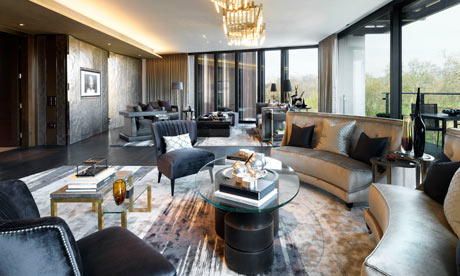
Mostly, our customers, although not without disposable income, tend not to come from the super-rich. Those who are serious about the acquisition of wealth have neither the time nor the stomach for the risks of commissioning individually designed furniture, unvalidated by the market or received opinion. Look at the pictures of the interior of One Hyde Park, designed by Lord Rogers for the Candy brothers developers and recently celebrated as the most expensive London perch at £6000 a square something or other. Luxury perhaps, but design originality no.
One Hyde Park: the cutting edge of design?
We should be grateful that our customers are people committed to individual engagement with small designers and makers, but they are not immune to the strains of the Candy-coloured economy that is enveloping us. In theUS , economic commentary increasingly remarks on the trickle (or perhaps stream) up. Maserati sales are booming; Lexus in serious decline, as the company loses sales on what one analyst calls 'the lower edge of luxury'.
GM HQ Detroit: the lower edge of luxury?
Few now subscribe to the idea of the rising tide lifting all boats. The idea that we are distinguished by the size of our boats, but that otherwise we all bob around quite unconstrained on a pond of equal opportunity seems to me bizarre. We exist and operate in a complex network of circumstances, relationships and mutual assumptions – social, economic, political, cultural, material – that partly and unequally determines our ability to respond to changed external circumstances. One needs to examine and perhaps alter that network as well as try to influence or recognise the changes in external circumstances. Indeed the two are not actually separate.
Our work as furniture designer-makers differs not just in its individuality but in its type. Some among us produce collectable furniture, furniture without a back, furniture that might seem more comfortable on a plinth as a sculptural object than against a mundane domestic wall. Unsurprisingly, this is the furniture that gets noticed: it is within at least occasional hailing distance of that ‘unusable, unaffordable and, preferably, unmakeable’ furniture so beloved of the press and critics (and whose creators would not dream of aligning themselves with any of the restrictive categories of ‘furniture’, ‘designer’ or ‘maker’).
Indirectly, this collectable furniture benefits us all: in the minds of some of our customers it effectively validates what we do on a humbler plane. How many of us have not seen a questioner’s brow clear when they say, ‘So, your work is like so-and-so’s’, naming some more celebrated member of our ranks? Yet it is a mixed blessing: it brings us work but, unless we challenge it outright, we may find it difficult to distance ourselves far from it. We may feel we have to keep up, or at least not fall too far behind, as it moves towards ever grander plinths. It also brings some risk of squeezing out humbler work from publication, exhibition selection and so on.
Things are not helped by our collective unsureness as to what are the primary qualities that we are selling with our furniture: and the public falls back to the default option of ‘antiques of the future’. Is it an intimate relationship with wood; is it craft, design, art; or is it a ‘bespoke’ service to answer highly particular practical needs? They are all qualities that we frequently invoke, but equally they all have limitations against which we sometimes feel compelled to protest. In a crude and unrigorous survey of the catalogue to an exhibition in which I participated in 2010 I found the following frequency to some key qualities: ‘commission/bespoke’ 19, ‘unique’ 14, ‘craft’ 14, ‘design’ 12, ‘beauty’ 12, ‘wood’ 11, ‘awards/prizes’ 8, ‘heritage/generations/timeless’ 8, ‘environment/sustainability’ 6, ‘tradition’ 2. They were not always (but were mostly) the actual words used – I was surprised how often ‘beauty’ occurred. Maybe I’ve missed some: there were a few references to functionality, but no-one mentioned modern technology or its capabilities.
Is it originality and uniqueness that we aim for? It comes second in my survey and there are some very bold claims within the catalogue to the current Millinery Works exhibition, not so much to be pushing the boundaries but to be stepping right outside them. (But a severe critic might say that when we do step outside the boundaries it is more a matter of distance than new direction.) Do such claims stand up? Is that what we should be doing? The early 21st century would be an unprecedented period of cultural innovation if we were. Or are we working within and developing a broad cultural movement, as furniture-makers before us have mostly done? Are we truly developing, as the exhibition claimed, the ‘Arts and Crafts legacy’? Do we truly know what it is? 'Tradition', T.S. Eliot wrote, 'cannot be inherited, and if you want it you must obtain it by great labour.'
Eliot had much of interest to say about artistic or cultural tradition that provides a useful antidote to our tendency to regard ‘traditional’ work as simply doing what has been done before, and ‘innovative’ work as the more valuable the less it has any connection with anything that has been done before. Eliot regarded cultural tradition as something more complex and dynamic than an all-pervading ether that we inhale involuntarily. It makes little sense that art which we struggle to comprehend when new should by the simple passage of years become something that we can apprehend without effort. Eliot thought that cultural tradition could only be apprehended fully through creative or critical/appreciative effort and that, in making such an effort we do not simply repeat what has gone before, but bring our own individual variation to its realisation, so creating a living tradition and changing, to a degree, the work of the past as well as that of the present. By such changes he did not mean the kind of ‘boundary breaking’ innovation that we frequently extol, but he did recognise that a culture could at times become stultifying rather than sustaining to the individuals who shared it – ‘So positive was the culture of that age [the eighteenth century] that it crushed a number of smaller men who thought differently but could not bear to face the fact’. He recognised that, as changes in sensibility and circumstances accumulate or accelerate, a culture periodically reaches a point where artistic expression has to change decisively to maintain its functioning viability: ‘Sensibility alters in us all from age to age whether we will or no, but expression is only changed by a man of genius.’ That genius he thought lay in artistic skill, not in intensity of personal vision. In fact, perhaps for reasons peculiar to his own personality, he was intensely hostile to allowing personality any role in artistic achievement: ‘The progress of an artist is a continual self-sacrifice, a continual extinction of personality.’ He believed that any artistic expression was, by its nature, a collaborative enterprise, and he was surely right in thinking that if art is great simply according to the intensity and uniqueness of the artist’s individual vision it becomes of interest to the rest of us just as spectacle or the object of shallow emulation, precluding his concept of a creative tradition.
Arts and Crafts furniture is at least then potentially an enormous element in our cultural inheritance whether we acknowledge, ignore or reject it, but I see little evidence that we are carrying it forward in any recognisable form overall. Some pieces in an earlier exhibition that appeared at first sight to relate most to Arts and Crafts had some pretty un-Arts and Crafts construction beneath.
Yet, for a sign of our times, if one looks at the website of the Society of Designer Craftsmen, which makes much of its direct descent from Walter Crane’s and William Morris’s Arts and Crafts Exhibition Society, one finds it proclaiming ‘Innovation, originality and quality are seen as integral elements of our work…we look for people who design and make original, beautiful, exciting, challenging works…we expect members to have a strong and innovative design sense…’ I’ve added the italics to point out the particular flavour of their advocacy. I’m in favour of those qualities myself, but is there not a degree of imbalance here? (How much excitement can one take in one’s dining table?) All that reiteration comes within a few sentences. It’s not exactly how Morris would have written: Morris, Gimson, the Barnsleys and others of the Arts and Crafts movement were innovative but were also keen to draw strength from aspects of tradition. Ironically the SDC goes on to say ‘We don’t accept work that is confined within the past tradition’. It’s not quite clear what they mean by that rather tortured phrase, or whether they’re referring to their own Arts and Crafts tradition – is that only to be invoked positively when considering the society as an organisation? Is tradition an in animate object? Perhaps it’s a polite way of saying ‘reproduction’; anyway, they don’t seem to have read much Eliot, and their words are, I think, symptomatic of the way in which we now give a reductive meaning to ‘tradition’ and regard it as excluding ‘innovation’, rather than seeing the two as interactive. It is also I think a little shaming that a society, descended from nineteenth-century artists and writers who thought deeply about culture and society, should show so little evidence of serious thought about artistic tradition but opt instead for something more akin to repetitive marketing-speak.
The curators of the designer-maker exhibitions to which I refer, struggle to give us a specific, positive identity as a group (far less write us a manifesto) and fall back to ‘it may not look like a movement but….’ Is our ultimate identity only a matter of superlatives?
Collectively, we seem able to ignore scarcely any furniture-making virtue of the past 150 years: the elegance of a Ruhlmann, the robustness of a Lutyens, the truth to materials of a Barnsley, the new materials of a Breuer, the simplicity of the Shakers, the decoration of a Bugatti, the flowing curves of a Guimard, the sculptural forms of a Gaudi, the linearity of a Gray, the innovation of a Rietveld, the tradition of a … well, there I’m lost for an immediate recent exemplar. But what other quality does our work not seem to lay claim to somewhere?
Are we, in the terms of one exhibition catalogue, striving to imbue our furniture with ‘expressive existence’ or is the creative process less singly driven, so that it attains its end when it embodies a state where intellectual and emotional satisfaction are indistinguishable? A large demand on a small canvass, but I have encountered a few such pieces of furniture (including a Barnsley piece). Perhaps it is a possible defining quality of ‘applied’ art that it seeks to resolve tensions, whilst ‘fine’ art need not.
If, in search of common ground beneath all our work, we say, as this catalogue does, that ‘workmanship’ is a ‘given’, although it words and places the idea carefully, we run some risk of again reinforcing that ‘antiques of the future’ preconception; for the public is able to appreciate not so much the inherent skill which can be found unostentatiously in work of many types, but the particular expression of skill that is only possible by taking many hours: high finish, complex jointing methods and detailing, unconventional construction, extravagant forms, wide variation of materials. ‘Ah! So that’, the public thinks, ‘is why it is all so expensive.’
Is there still, in the full sense of the word, a place for ‘respectable’ furniture any more? Are we still able, in our culture, to respect something that is not innovative? If tradition has a specific, realisable meaning for us now we should be. Yet we inhabit a growth-and-progress culture which finds it almost impossible to regard embodying the future as anything but the highest virtue in a new artefact, and, although we can just about consider the possibility of cultural deficit in our obsessive contemplation of the character of each new decade, successive centuries are invariably regarded as inevitable advances, so that ‘21st-century’ glibly replaces ‘20th-century’ as a term of approbation and new hope. The hollowness of our collective cultural analysis is perhaps illustrated by the fact that, at the same time, the revered artworks of the past achieve astronomical monetary values, and, although price levels fluctuate, the work of any individual is hardly ever evicted from the financially approved canon by changes in cultural values and interests – but individual works can be admitted or removed by attribution or de-attribution almost regardless of aesthetic appeal, in something akin to financial re-engineering. It is the function of the ‘criticariat’ to translate the new, the ‘work of the future’ as rapidly as possible into the collected, valued, traded, sanctified ranks of our cultural ‘heritage’. That process is now brought to such a pitch of efficiency that it can be completed within a few years, rather than having to wait for the passing of a generation or the gradual shifting of sensibility (from future to past with minimal lingering in the present), and selected living artists simultaneously (it would seem) both challenge and embody our cultural assumptions. Eat your heart out, Van Gogh. This, in more rarefied form, is the mechanism of ‘antiques of the future’: in our case it works rather more slowly and uncertainly.
We maybe have to accept as designer-makers of furniture that we survive at the margin and sometimes in odd, though possibly moderately comfortable, niches. I hope not, but there are worse fates.
Furniture designer-makers tend to be uneasy about the relatively high prices they have to ask for their work. They would like it to be widely accessible, not so much for commercial reasons but because of the relationship they would like to see themselves having to wider society. In that little has changed since the days of William Morris.
Mostly, our customers, although not without disposable income, tend not to come from the super-rich. Those who are serious about the acquisition of wealth have neither the time nor the stomach for the risks of commissioning individually designed furniture, unvalidated by the market or received opinion. Look at the pictures of the interior of One Hyde Park, designed by Lord Rogers for the Candy brothers developers and recently celebrated as the most expensive London perch at £6000 a square something or other. Luxury perhaps, but design originality no.
One Hyde Park: the cutting edge of design?
We should be grateful that our customers are people committed to individual engagement with small designers and makers, but they are not immune to the strains of the Candy-coloured economy that is enveloping us. In the
GM HQ Detroit: the lower edge of luxury?
Few now subscribe to the idea of the rising tide lifting all boats. The idea that we are distinguished by the size of our boats, but that otherwise we all bob around quite unconstrained on a pond of equal opportunity seems to me bizarre. We exist and operate in a complex network of circumstances, relationships and mutual assumptions – social, economic, political, cultural, material – that partly and unequally determines our ability to respond to changed external circumstances. One needs to examine and perhaps alter that network as well as try to influence or recognise the changes in external circumstances. Indeed the two are not actually separate.
Our work as furniture designer-makers differs not just in its individuality but in its type. Some among us produce collectable furniture, furniture without a back, furniture that might seem more comfortable on a plinth as a sculptural object than against a mundane domestic wall. Unsurprisingly, this is the furniture that gets noticed: it is within at least occasional hailing distance of that ‘unusable, unaffordable and, preferably, unmakeable’ furniture so beloved of the press and critics (and whose creators would not dream of aligning themselves with any of the restrictive categories of ‘furniture’, ‘designer’ or ‘maker’).
Indirectly, this collectable furniture benefits us all: in the minds of some of our customers it effectively validates what we do on a humbler plane. How many of us have not seen a questioner’s brow clear when they say, ‘So, your work is like so-and-so’s’, naming some more celebrated member of our ranks? Yet it is a mixed blessing: it brings us work but, unless we challenge it outright, we may find it difficult to distance ourselves far from it. We may feel we have to keep up, or at least not fall too far behind, as it moves towards ever grander plinths. It also brings some risk of squeezing out humbler work from publication, exhibition selection and so on.
Things are not helped by our collective unsureness as to what are the primary qualities that we are selling with our furniture: and the public falls back to the default option of ‘antiques of the future’. Is it an intimate relationship with wood; is it craft, design, art; or is it a ‘bespoke’ service to answer highly particular practical needs? They are all qualities that we frequently invoke, but equally they all have limitations against which we sometimes feel compelled to protest. In a crude and unrigorous survey of the catalogue to an exhibition in which I participated in 2010 I found the following frequency to some key qualities: ‘commission/bespoke’ 19, ‘unique’ 14, ‘craft’ 14, ‘design’ 12, ‘beauty’ 12, ‘wood’ 11, ‘awards/prizes’ 8, ‘heritage/generations/timeless’ 8, ‘environment/sustainability’ 6, ‘tradition’ 2. They were not always (but were mostly) the actual words used – I was surprised how often ‘beauty’ occurred. Maybe I’ve missed some: there were a few references to functionality, but no-one mentioned modern technology or its capabilities.
Is it originality and uniqueness that we aim for? It comes second in my survey and there are some very bold claims within the catalogue to the current Millinery Works exhibition, not so much to be pushing the boundaries but to be stepping right outside them. (But a severe critic might say that when we do step outside the boundaries it is more a matter of distance than new direction.) Do such claims stand up? Is that what we should be doing? The early 21st century would be an unprecedented period of cultural innovation if we were. Or are we working within and developing a broad cultural movement, as furniture-makers before us have mostly done? Are we truly developing, as the exhibition claimed, the ‘Arts and Crafts legacy’? Do we truly know what it is? 'Tradition', T.S. Eliot wrote, 'cannot be inherited, and if you want it you must obtain it by great labour.'
Eliot had much of interest to say about artistic or cultural tradition that provides a useful antidote to our tendency to regard ‘traditional’ work as simply doing what has been done before, and ‘innovative’ work as the more valuable the less it has any connection with anything that has been done before. Eliot regarded cultural tradition as something more complex and dynamic than an all-pervading ether that we inhale involuntarily. It makes little sense that art which we struggle to comprehend when new should by the simple passage of years become something that we can apprehend without effort. Eliot thought that cultural tradition could only be apprehended fully through creative or critical/appreciative effort and that, in making such an effort we do not simply repeat what has gone before, but bring our own individual variation to its realisation, so creating a living tradition and changing, to a degree, the work of the past as well as that of the present. By such changes he did not mean the kind of ‘boundary breaking’ innovation that we frequently extol, but he did recognise that a culture could at times become stultifying rather than sustaining to the individuals who shared it – ‘So positive was the culture of that age [the eighteenth century] that it crushed a number of smaller men who thought differently but could not bear to face the fact’. He recognised that, as changes in sensibility and circumstances accumulate or accelerate, a culture periodically reaches a point where artistic expression has to change decisively to maintain its functioning viability: ‘Sensibility alters in us all from age to age whether we will or no, but expression is only changed by a man of genius.’ That genius he thought lay in artistic skill, not in intensity of personal vision. In fact, perhaps for reasons peculiar to his own personality, he was intensely hostile to allowing personality any role in artistic achievement: ‘The progress of an artist is a continual self-sacrifice, a continual extinction of personality.’ He believed that any artistic expression was, by its nature, a collaborative enterprise, and he was surely right in thinking that if art is great simply according to the intensity and uniqueness of the artist’s individual vision it becomes of interest to the rest of us just as spectacle or the object of shallow emulation, precluding his concept of a creative tradition.
Arts and Crafts furniture is at least then potentially an enormous element in our cultural inheritance whether we acknowledge, ignore or reject it, but I see little evidence that we are carrying it forward in any recognisable form overall. Some pieces in an earlier exhibition that appeared at first sight to relate most to Arts and Crafts had some pretty un-Arts and Crafts construction beneath.
Yet, for a sign of our times, if one looks at the website of the Society of Designer Craftsmen, which makes much of its direct descent from Walter Crane’s and William Morris’s Arts and Crafts Exhibition Society, one finds it proclaiming ‘Innovation, originality and quality are seen as integral elements of our work…we look for people who design and make original, beautiful, exciting, challenging works…we expect members to have a strong and innovative design sense…’ I’ve added the italics to point out the particular flavour of their advocacy. I’m in favour of those qualities myself, but is there not a degree of imbalance here? (How much excitement can one take in one’s dining table?) All that reiteration comes within a few sentences. It’s not exactly how Morris would have written: Morris, Gimson, the Barnsleys and others of the Arts and Crafts movement were innovative but were also keen to draw strength from aspects of tradition. Ironically the SDC goes on to say ‘We don’t accept work that is confined within the past tradition’. It’s not quite clear what they mean by that rather tortured phrase, or whether they’re referring to their own Arts and Crafts tradition – is that only to be invoked positively when considering the society as an organisation? Is tradition an in animate object? Perhaps it’s a polite way of saying ‘reproduction’; anyway, they don’t seem to have read much Eliot, and their words are, I think, symptomatic of the way in which we now give a reductive meaning to ‘tradition’ and regard it as excluding ‘innovation’, rather than seeing the two as interactive. It is also I think a little shaming that a society, descended from nineteenth-century artists and writers who thought deeply about culture and society, should show so little evidence of serious thought about artistic tradition but opt instead for something more akin to repetitive marketing-speak.
The curators of the designer-maker exhibitions to which I refer, struggle to give us a specific, positive identity as a group (far less write us a manifesto) and fall back to ‘it may not look like a movement but….’ Is our ultimate identity only a matter of superlatives?
Collectively, we seem able to ignore scarcely any furniture-making virtue of the past 150 years: the elegance of a Ruhlmann, the robustness of a Lutyens, the truth to materials of a Barnsley, the new materials of a Breuer, the simplicity of the Shakers, the decoration of a Bugatti, the flowing curves of a Guimard, the sculptural forms of a Gaudi, the linearity of a Gray, the innovation of a Rietveld, the tradition of a … well, there I’m lost for an immediate recent exemplar. But what other quality does our work not seem to lay claim to somewhere?
Are we, in the terms of one exhibition catalogue, striving to imbue our furniture with ‘expressive existence’ or is the creative process less singly driven, so that it attains its end when it embodies a state where intellectual and emotional satisfaction are indistinguishable? A large demand on a small canvass, but I have encountered a few such pieces of furniture (including a Barnsley piece). Perhaps it is a possible defining quality of ‘applied’ art that it seeks to resolve tensions, whilst ‘fine’ art need not.
If, in search of common ground beneath all our work, we say, as this catalogue does, that ‘workmanship’ is a ‘given’, although it words and places the idea carefully, we run some risk of again reinforcing that ‘antiques of the future’ preconception; for the public is able to appreciate not so much the inherent skill which can be found unostentatiously in work of many types, but the particular expression of skill that is only possible by taking many hours: high finish, complex jointing methods and detailing, unconventional construction, extravagant forms, wide variation of materials. ‘Ah! So that’, the public thinks, ‘is why it is all so expensive.’
Is there still, in the full sense of the word, a place for ‘respectable’ furniture any more? Are we still able, in our culture, to respect something that is not innovative? If tradition has a specific, realisable meaning for us now we should be. Yet we inhabit a growth-and-progress culture which finds it almost impossible to regard embodying the future as anything but the highest virtue in a new artefact, and, although we can just about consider the possibility of cultural deficit in our obsessive contemplation of the character of each new decade, successive centuries are invariably regarded as inevitable advances, so that ‘21st-century’ glibly replaces ‘20th-century’ as a term of approbation and new hope. The hollowness of our collective cultural analysis is perhaps illustrated by the fact that, at the same time, the revered artworks of the past achieve astronomical monetary values, and, although price levels fluctuate, the work of any individual is hardly ever evicted from the financially approved canon by changes in cultural values and interests – but individual works can be admitted or removed by attribution or de-attribution almost regardless of aesthetic appeal, in something akin to financial re-engineering. It is the function of the ‘criticariat’ to translate the new, the ‘work of the future’ as rapidly as possible into the collected, valued, traded, sanctified ranks of our cultural ‘heritage’. That process is now brought to such a pitch of efficiency that it can be completed within a few years, rather than having to wait for the passing of a generation or the gradual shifting of sensibility (from future to past with minimal lingering in the present), and selected living artists simultaneously (it would seem) both challenge and embody our cultural assumptions. Eat your heart out, Van Gogh. This, in more rarefied form, is the mechanism of ‘antiques of the future’: in our case it works rather more slowly and uncertainly.
We maybe have to accept as designer-makers of furniture that we survive at the margin and sometimes in odd, though possibly moderately comfortable, niches. I hope not, but there are worse fates.
Monday, 15 March 2010

Thoughts from an exhibition
21st CENTURY FURNITURE
THE ARTS & CRAFTS LEGACY
This exhibition, of the work of about forty designer-makers, is now closed, but it prompted these thoughts about our relationship to the work of the Arts and Crafts furniture makers.
Wood is a humanly comfortable material in the ways in which it looks, feels and smells. We shape and work it with tools that were, essentially, developed generations ago. We celebrate its sometimes fickle and inconvenient properties and like to think our wooden furniture links us to a natural and living material, placing us a little more securely in the biosphere. Yet woodworking is an artifice and, perhaps, a deception. Almost everything required in seasoned wood furniture construction is at odds with the mechanics of the living tree and its properties as a harvested material. The Arts and Crafts movement strove to accept and demonstrate the material’s nature and limitations, expressing them in its constructional methods – partly in reaction to the virtuoso achievements of eighteenth and nineteenth century cabinet-making. It is an open question in some respects which approach is the more ‘honest’ or fruitful for us today, though we cleave to the Arts and Crafts’ reassertion of the autonomy of craft. In my design and making I, like others, continue that debate between nature and artifice.
Subscribe to:
Posts (Atom)